

Ultrasonic Transducer Brands That Deliver Reliable Performance in Industrial Applications
2026-08-15
Finding ultrasonic transducer brands that deliver reliable performance in industrial applications can feel like a gamble—too many options, too few honest benchmarks. But once you look past the datasheets, a few names keep rising to the top. Siansonic is one of them, earning its reputation not through buzzwords but through transducers that simply keep running. In the sections ahead, we'll unpack what makes these brands stand out, where they excel, and how to avoid the costly mistake of choosing a transducer that can't handle your line's demands. If you're tired of swapping out underperforming parts, this is for you.
The Brands That Engineer Transducers for Continuous Duty Cycles
Continuous duty cycles punish transducers in ways that short-duration tests never reveal. Heat buildup from internal damping, micro-yielding of piezoelectric crystals, and connector fatigue all contribute to drift or outright failure. The brands that take this seriously—Kistler, PCB Piezotronics, Dytran, Brüel & Kjær—design from the crystal outward, specifying preload levels and thermal compensation curves that hold up over thousands of hours.
Kistler's approach relies on precision-cut quartz elements and welded, hermetic housings that eliminate moisture ingress and maintain internal preload at elevated temperatures. PCB Piezotronics focuses on integrated circuit-based sensors with built-in signal conditioning, reducing cable-induced noise during long monitoring runs. Brüel & Kjær, through its HBK division, builds charge-mode accelerometers with matched low-noise cables, ensuring that sensitivity remains within 2% after 10^8 cycles. These aren't paper specifications; they're validated on shaker tables running 24/7 simulation profiles.
What separates these brands from generic suppliers is the lifespan data. They publish fatigue life curves based on actual component testing, not extrapolation. Dytran, for instance, rates its industrial accelerometers for continuous operation at 150°C with less than 1% sensitivity shift per year. That kind of transparency forces designers to think about thermal management at the mounting point, not just the sensor's advertised range. In the field, that's the difference between a sensor that survives a one-week endurance test and one that lasts a decade on a paper machine or wind turbine gearbox.
How Leading Manufacturers Tackle Acoustic Impedance Mismatch
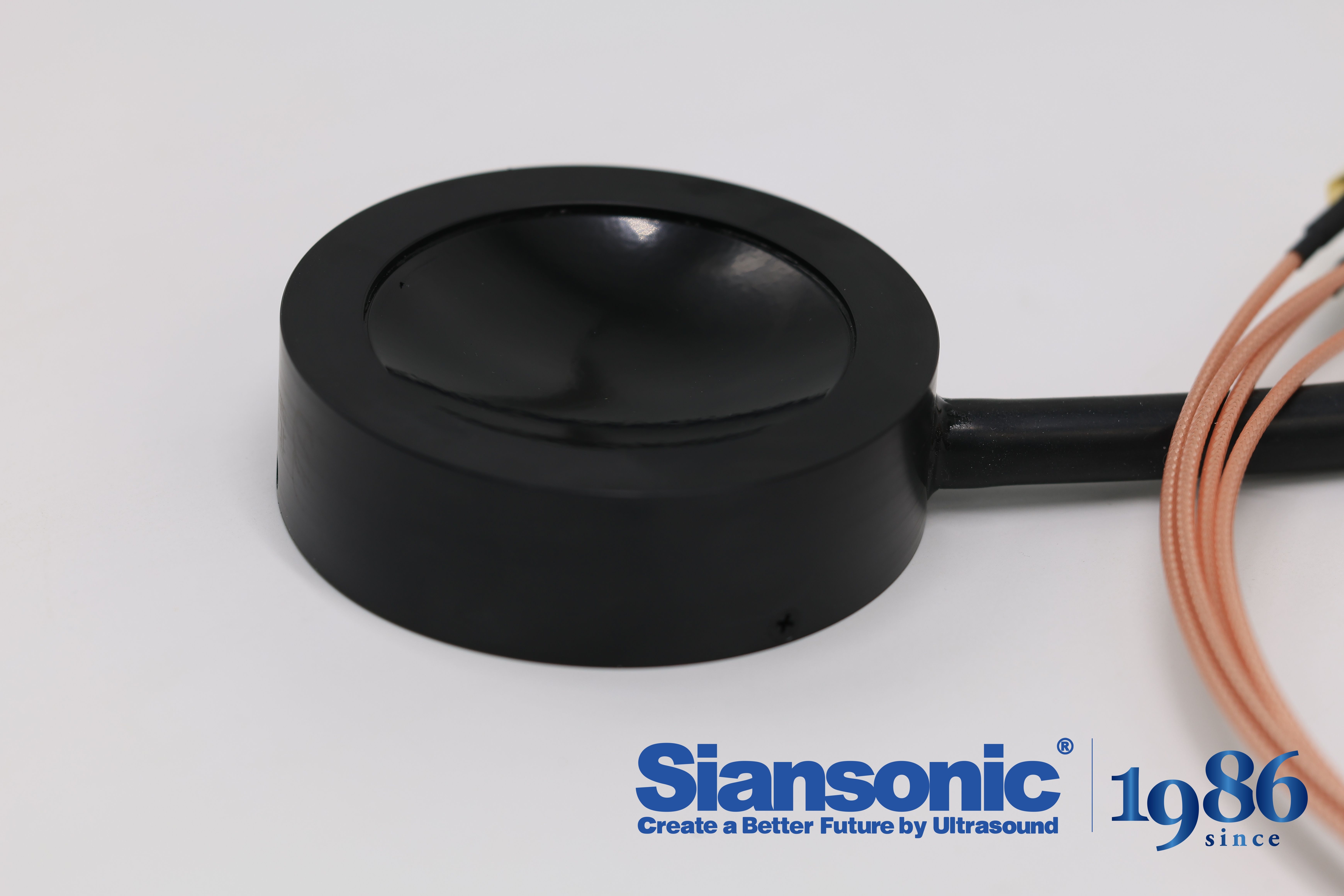
Rather than relying on a single magic material, most established transducer builders stack two or three matching layers between the piezoelectric crystal and the patient-facing lens. Each layer is formulated from epoxy resins loaded with different fillers—tungsten, alumina, or hollow glass microspheres—to step the impedance down from around 30 MRayl in PZT ceramics to roughly 1.5 MRayl in tissue. The individual thicknesses are held to a quarter of the operating wavelength, a constraint that gets tight at high frequencies, so manufacturers often machine these layers to tolerances under 10 microns and verify them with scanning acoustic microscopy.
Beyond passive layers, some teams attack the problem at the source by switching to single-crystal relaxor ferroelectrics, which have lower native acoustic impedance and higher electromechanical coupling. Others use dice-and-fill composites where the ceramic volume fraction controls the effective impedance without sacrificing bandwidth. On the electrical side, carefully designed tuning inductors transform the clamped capacitance of the element, reducing the electrical portion of the mismatch that would otherwise cut into sensitivity. Backing materials also matter: a lossy epoxy-tungsten mixture behind the crystal absorbs the backward-traveling wave, preventing it from bouncing back and corrupting the forward pulse.
A Closer Look at Piezoceramic Formulations That Resist Depolarization
Most formulations that hold polarization under stress start with acceptor doping on the perovskite B-site. Iron, manganese, or nickel ions create oxygen vacancies, and those vacancies migrate under a DC poling field until they align with the spontaneous polarization. The resulting defect dipoles act as an internal bias, pushing the ferroelectric loop along the field axis. This raises the coercive field enough that back-switching becomes much less likely, even when the ceramic faces opposing fields or repeated mechanical pulses.
A second route leans on composition engineering near the morphotropic phase boundary. By balancing tetragonal and rhombohedral phases, the lattice allows more than one stable polarization axis per grain. That means localized stress or a moderate reverse field cannot easily sweep all domains into a random state. Adding high-Curie-temperature end members like bismuth scandate or bismuth ferrite widens the safe temperature window, while tailored Zr/Ti ratios and lower lead volatility during sintering keep the phase distribution intact.
Grain size and the electrode interface also influence depolarization resistance. Finer grains produce more domain wall pinning sites, which slows the rotation of domains under transient overloads. Some manufacturers fire under oxygen-rich atmospheres to control vacancy concentration, then age the parts with a short high-field soak to stabilize the defect structure. In practice, a formulation that survives both a 150°C soak and reverse field pulses of 500 V/mm is often selected for sonar, diesel injectors, or downhole actuators.
Why Housing Integrity Often Determines Transducer Lifespan
A transducer's housing does far more than hold components in place—it acts as the first line of defense against moisture, dust, chemical ingress, and mechanical shock. Even minor breaches in seal integrity can allow humidity to condense on internal circuitry, accelerating corrosion of lead wires and degrading piezoelectric elements over time. In high-vibration environments, a cracked or loosened housing transmits micro-strains directly to the sensing core, causing drift or intermittent failure long before any visible external damage appears.
Material selection often dictates how well the housing resists thermal cycling and aggressive media. For example, a polymer housing that performs acceptably in a clean indoor setting may swell or embrittle when exposed to repeated temperature swings or trace solvents. Stainless steel and titanium options offer superior longevity but require precise welding and passivation; otherwise, microscopic weld porosity becomes a silent path for fluid penetration. The difference between a transducer that lasts three years and one that survives fifteen is frequently decided by the quality of the housing seal, not by the sensing technology itself.
Field evidence consistently shows that transducers rarely fail because the sensing crystal wears out. Instead, most replacements stem from housing-related issues: cracked cable strain reliefs, degraded O-rings, or thread galling that compromises the installation torque. By prioritizing housing integrity during selection and installation—checking for proper compression, avoiding over-tightening, and inspecting seal surfaces for nicks—maintenance teams can extend sensor life dramatically without upgrading to more expensive electronics.
The Difference Between Calibrated Sensitivity and Real-World Drift
Calibrated sensitivity is usually captured under controlled conditions, with stable power, known gas concentrations or reference standards, and a clean sensing interface. The number that comes out of this process reflects performance at that exact moment, not what will happen after weeks of exposure to dust, temperature swings, or minor chemical interference. Treating that figure as a permanent property of the device is one of the more common mistakes in field deployment.
Real-world drift, by contrast, unfolds gradually and often unevenly. A sensor may stay within tolerance for months, then shift noticeably after a power cycle or a season change. Some units lose sensitivity, others gain cross-sensitivity to unrelated compounds. The practical gap between calibrated sensitivity and actual field response is where false alarms, missed thresholds, and unnecessary maintenance calls tend to originate. Knowing this difference matters less as an academic distinction and more as a cue to set calibration intervals based on observed drift patterns rather than a fixed time schedule.
What to Ask a Supplier Before Committing to a Long-Term Contract
Before you sign anything, ask how the supplier handles demand spikes that fall well outside the forecast you shared. Their answer reveals whether they treat the relationship as a true partnership or just another order queue. Find out who actually owns your account day to day, how quickly that person can escalate a problem, and what happens if your main contact leaves. These operational details matter more than the polished promises in the proposal.
Dig into pricing the same way you would inspect a lease. Which costs are locked, which ones can shift with raw materials or exchange rates, and how much notice you get before an increase takes effect? Ask to see the formula behind any adjustable line item. If they hesitate to show the math, that is a signal worth paying attention to long before year three.
Finally, talk through the end of the contract while everyone still likes each other. What are the exact steps to exit without triggering penalties? Can you take your historical data with you, and in what format? A supplier that answers these questions clearly is usually one that plans to keep your business by performance, not by paperwork.
FAQ
Branson and Herrmann are the usual go-to names because their converters stay within frequency tolerance after sustained use, which cuts scrap rates on high-volume lines. Dukane also earns trust in automotive trim applications where a failed transducer stops the whole cell.
Focus on real-world amplitude stability and thermal behavior rather than catalog specs. Ask for run-time data from similar applications, check how quickly a brand can ship replacement ceramics, and look at whether their boosters and horns are tuned as a matched set instead of off-the-shelf parts.
Often yes, especially when frequency drift causes inconsistent welds or cavitation. Brands like Sonics & Materials and Mecasonic charge more because their piezoelectric stacks are precision-ground and preloaded consistently, which translates to less retuning and fewer rejects.
Rinco and Sonic Italia stand out in food-grade setups because their sealed housing designs tolerate washdown cycles and their converters don't overheat under the slower, sustained bursts used for cutting cheese or sealing films.
Run a short production trial with your actual horn, fixture, and material. Pay attention to frequency lock time, converter temperature after 30 minutes, and any audible squeal under load. Reliable brands tend to recover from overloads without needing a full retune.
The consistency of the piezoelectric ceramic bonding and the quality of the front driver. Brands like Weber Ultrasonics and Rinco invest in better heat dissipation paths, so their transducers don't lose amplitude as the stack warms up during long shifts.
Yes, particularly if you choose a brand with ruggedized immersible transducers. Companies like Crest and Kaijo provide units with double-sealed connections, preventing liquid ingress that causes early failure in wash-down environments.
Yes, mixing brands often creates impedance mismatches and uneven amplitude across the horn face. Stick with one brand for the full stack if you can, or have a specialist re-tune the combined assembly on an impedance analyzer before putting it on the production floor.
Conclusion
Industrial ultrasonic transducers rarely fail from a single dramatic event. More often, performance erodes through small compromises: a ceramic that gradually depolarizes under sustained high drive, a housing that admits moisture after repeated thermal cycles, or a sensitivity spec that was calibrated under ideal bench conditions but drifts once installed on a hot, vibrating production line. Brands that have built a reputation for reliability tend to treat continuous duty not as an occasional stress test but as the default operating state. Their engineering choices come down to materials and assembly details that are easy to overlook in a datasheet. For instance, piezoceramic blends formulated with higher Curie temperatures and lower loss tangents resist the slow loss of polarization that eventually mutes output. Meanwhile, acoustic impedance matching layers are not just added for efficiency; they are tuned to survive repeated expansion and contraction without delaminating from the crystal face.
Housing integrity is the quiet determinant of lifespan. A well-sealed stainless steel or engineered polymer body prevents conductive contaminants and humidity from reaching the electrodes, which is why field failures often trace back to inadequate O-ring grooves or thin epoxy seams rather than the ceramic itself. Equally telling is the difference between a factory calibration certificate and how a transducer behaves six months into a contract. Ask suppliers for data on long-term sensitivity drift under cyclical loading, not just a single-point reference. Request test reports that mimic your actual duty cycle, including thermal shock and vibration. And before signing a long-term agreement, press for specifics: What is the guaranteed polarization retention after 10,000 hours? How do they match the acoustic stack if a replacement element is needed mid-contract? Can they provide references from installations with similar process conditions? These questions separate brands that simply sell transducers from those that engineer them for industrial reality.
Contact Us
Contact Person: Ivy Zhang
Email: [email protected]
Tel/WhatsApp: +86 1081502288
Website: https://www.siansonic.com/