

Triisopropanolamine Sales Manufacturer Guide for Reliable Chemical Sourcing
2026-10-22
Sourcing triisopropanolamine can feel like navigating a maze of vague specs and unverified suppliers. One wrong move and your production line pays the price. That’s why we’ve put together this no-nonsense guide to finding manufacturers who actually deliver consistency—without the guesswork. While many names float around the market, few back their claims with real-world performance like HAISEN. Stick with us and you’ll learn how to cut through the noise, ask the right questions, and secure a supply chain you can trust.
What Actually Matters When Vetting a TIPA Supplier
Most procurement checklists stop at price per kilo and ISO paperwork, but those rarely predict how a TIPA supplier will behave when your production line is waiting. Start with their raw material sourcing: ask for the actual mill certificates for triisopropanolamine, not a summary, and check if their upstream supply is diversified or single-sourced. A supplier who can walk you through their inventory buffer and reorder triggers is far more likely to keep your orders moving than one who quotes a perfect lead time but holds no safety stock.
Beyond the spec sheet, watch how they handle deviations. Every chemical batch drifts—color, moisture, impurity profile. The real question is whether the supplier flags a borderline lot before shipping or waits for you to catch it in QC. Ask for a recent example of a rejected batch and what they did about it. If they can't describe a concrete corrective action, you're buying from a reseller, not a partner.
Finally, verify their logistics and packaging under real conditions. TIPA is hygroscopic and viscous; drums that are fine in a temperate warehouse can leak or absorb water on a long sea freight. Ask for references from customers in your climate zone, and check whether they use nitrogen blanketing, lined closures, or desiccant bags as standard. These small details separate suppliers who understand the molecule from those who just move containers.
The Overlooked Quality Signals in Triisopropanolamine Spec Sheets
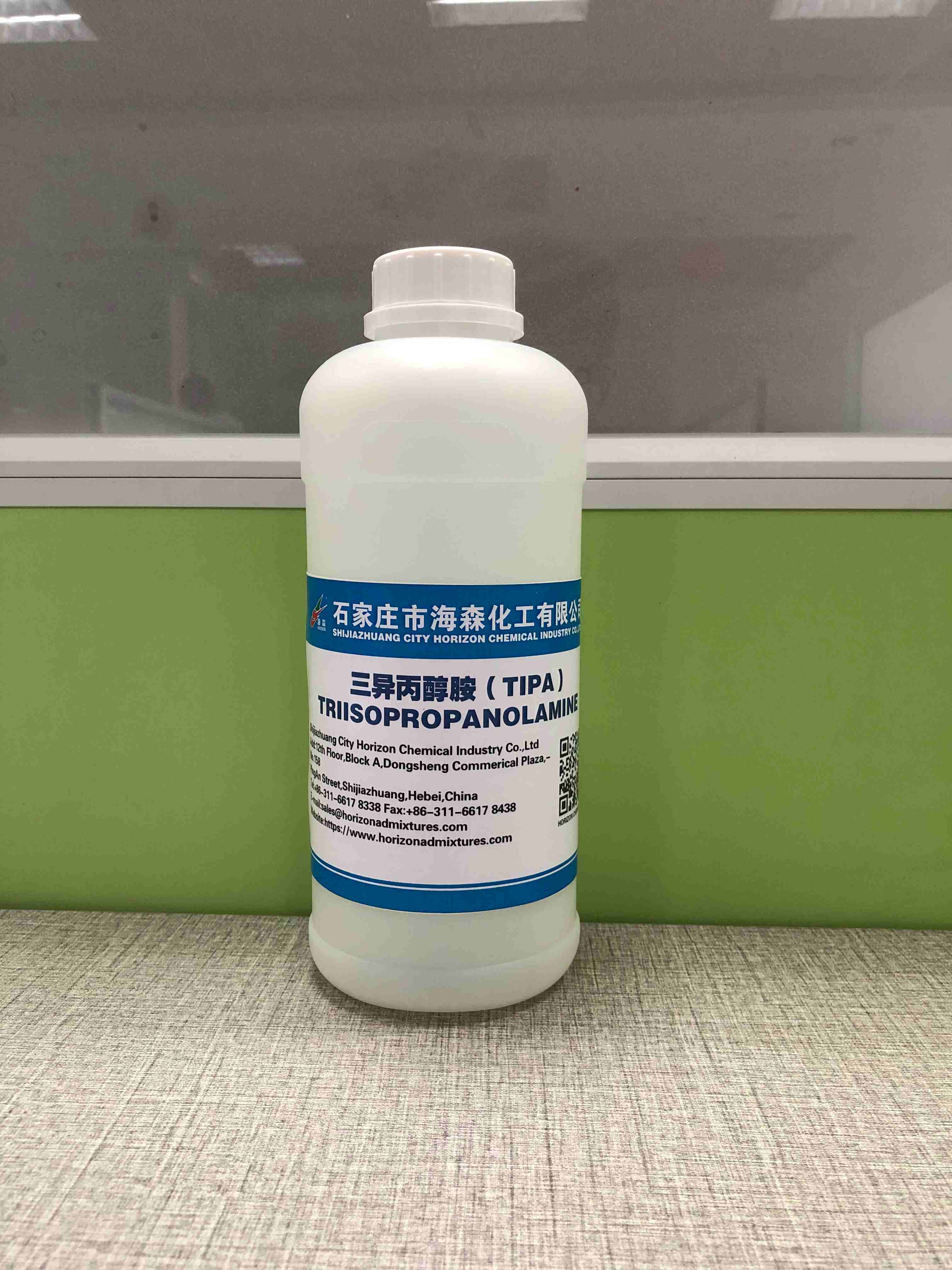
Most buyers glance at amine value, moisture, and color when scanning a triisopropanolamine spec sheet. But the real indicators of batch consistency often hide in the fine print nobody reads. Residue on ignition, for instance, can quietly reveal how thoroughly the manufacturer stripped out catalyst fines or neutralized acidic byproducts. A few extra milligrams per gram might not change the titration number, yet it can shift long-term stability in cement grinding aid formulations.
Another signal: the ratio of secondary to tertiary amine isomers. Spec sheets rarely list it, but variations here can alter chelation behavior and pH buffering capacity. A triisopropanolamine with a tight isomer window tends to perform more predictably in metalworking fluids, even when the headline purity looks identical. Ask suppliers for that breakdown and watch how quickly the vague answers appear.
Then there’s the odor profile. Not a formal spec, but a trained nose can pick up residual ammonia or isopropanol that a GC-MS column might flag only as a minor peak. Those traces are often the first sign of incomplete distillation or a rushed neutralization step. If your current lot suddenly smells sharper than the last, the spec sheet won’t tell you why—but your downstream blend stability will, a few weeks later.
How Regional Production Differences Affect Your Sourcing Decision
A factory in Guangdong rarely builds the same product the same way as one in Monterrey or Ho Chi Minh City, even when the drawings are identical. Local wage structures, energy costs, and the density of suppliers shape not just the final price, but how easily a line can scale or switch to a new revision. Buyers who compare only unit costs often miss the more expensive reality: a region with cheap labor may have slower tooling turnarounds, while a higher-wage cluster might absorb design changes without pausing production.
Regulatory gaps and enforcement differences also change what you are actually buying. A region known for loose environmental oversight might quote lower, but that cost advantage can vanish when your own audits demand retrofits, or when import rules in your home market tighten. Similarly, clusters with deep technical training tend to produce fewer hidden defects, reducing the need for third-party inspection layers that eat into margins elsewhere.
Distance from raw materials and port capacity determines whether a regional price difference survives the first disruption. A supplier far from aluminum mills or semiconductor fabs may look attractive in calm months, yet its lead times stretch unpredictably during allocation periods. Meanwhile a costlier region with shorter inland routes and duplicate logistics options can keep your shelf stock leaner, which often outweighs a three percent unit-price gap.
Negotiating Supply Agreements Without Sacrificing Purity
Supply negotiations often hinge on price, lead times, and volume discounts, but purity requirements must be treated as non-negotiable boundaries rather than bargaining chips. A practical approach is to predefine acceptable purity thresholds, including testing methods and tolerance ranges, in the initial request for proposal. This removes ambiguity later and prevents a supplier from offering a lower quote by quietly substituting a lower-grade input.
It also helps to separate the commercial terms from the technical specifications early in the conversation. Instead of blending purity into a single bundled price, ask suppliers to itemize the cost of meeting your purity standard—such as dedicated production lines, additional filtration, or third-party batch testing. When both sides see the actual cost driver, negotiations can focus on volume commitments or payment terms to offset it, rather than on relaxing the purity bar.
Finally, build verification into the agreement itself. Specify that each shipment requires a certificate of analysis from an accredited lab, and include the right to conduct unannounced audits or reject non-conforming batches without penalty. Suppliers who push back on these clauses are often revealing where their cost savings come from. The goal is not to make the contract adversarial, but to make purity measurable, enforceable, and immune to last-minute trade-offs.
Spotting Red Flags Before They Reach Your Production Line
A subtle vibration in a bearing, a slight discoloration on a circuit board, a tiny variance in torque readings—these are the whispers your equipment gives before a full-blown failure. Waiting until a defect reaches the assembly stage means scrap, rework, and downtime that quietly eat into margins. The goal is to train your eyes and your data systems on the moments when a process starts drifting, not when it has already gone off the rails.
Most production problems don't announce themselves with a bang. They show up as patterns: a particular batch from one supplier failing leak tests at three times the normal rate, or a conveyor speed that creeps upward after a maintenance shift. By setting narrower control bands around critical parameters—temperature, pressure, alignment, material thickness—you create an early warning system that flags inconsistencies before they become defects.
Operators and engineers need a simple triage habit: if something looks slightly different, sounds off, or produces numbers outside the usual range, it deserves a ten-minute investigation, not a shrug. Document these micro-deviations in a shared log. Over time, you'll see recurring signals that predict larger failures, and you can adjust maintenance or supplier specs accordingly. That's how you stop red flags from becoming red lights on your line.
Building a Sourcing Playbook That Survives Market Swings
A sourcing playbook that holds up when markets swing isn’t a fixed list of preferred vendors. It’s a set of decision rules that assume volatility is the default. Start by mapping every critical input to at least two viable supply paths, even if one carries a smaller share of volume. Build in regional alternatives that can be activated without a lengthy qualification cycle. The goal isn’t to chase the lowest unit cost at all times; it’s to protect flow while keeping total landed cost within an acceptable band.
Scenario planning makes the difference between reacting and responding. For each major category, define two or three market states—tight capacity, demand shock, price spike—and attach clear triggers for switching suppliers, renegotiating terms, or pulling inventory forward. Include a cost model that separates raw material, logistics, and conversion costs so you can see which levers actually move when conditions change. That visibility lets procurement act on numbers instead of panic.
Finally, keep the playbook alive through regular supplier conversations and internal reviews. No document survives contact with a real disruption unless the relationships and data feeds behind it are current. Use simple metrics like lead time variability and fill rate as early warnings, not just cost savings. When the next swing hits, the team should already know which levers to pull and who owns each decision.
FAQ
Look for purity above 99%, low water content, clear appearance, and consistent isomer distribution. Reputable suppliers provide a certificate of analysis with every batch.
Request production process details, audit certifications like ISO 9001, and ask for client references in your industry. A plant tour or third-party inspection also reveals a lot about handling and quality control.
Cement grinding aids and metalworking fluids typically need low impurity levels, while some surfactant formulations tolerate technical grade. Always match the grade to your process tolerance.
Regional production concentration, raw material price swings for propylene oxide, and logistics delays during peak shipping seasons. Keeping a second qualified supplier reduces interruption risk.
Direct purchasing works for large volumes and allows custom specs and pricing. Distributors offer smaller lots, local warehousing, and faster delivery but at a markup.
Commercial invoice, packing list, bill of lading, certificate of analysis, safety data sheet, and any customs declarations. Ensure the SDS matches the exact product grade.
Compare delivered price per kilogram of active content, not just list price. Consider freight, duties, payment terms, and rejection/return policies.
Vague or missing certificate of analysis, reluctance to share production records, unusually low prices, inconsistent batch numbers, or high levels of unknown impurities in lab tests.
Conclusion
Selecting a dependable triisopropanolamine supplier requires looking past glossy marketing and instead probing the operational details that directly influence product consistency. A thorough vetting process should examine whether the manufacturer can demonstrate batch-to-batch uniformity, transparent handling of impurities, and a clear grasp of how feedstock origins and synthesis routes shape the final amine profile. Too often buyers focus solely on price per kilogram, yet regional production nuances—such as variations in raw material availability or local environmental regulations—can quietly alter performance in downstream formulations. Pairing these insights with a close reading of specification sheets for overlooked markers like moisture content, color stability, and residual alcohol levels reveals far more about real-world reliability than a simple purity percentage ever could.
Negotiating long-term supply agreements demands a balance between locking in favorable terms and preserving the chemical integrity your processes depend on. Suppliers who resist sharing batch records or who push for overly flexible purity allowances deserve extra scrutiny, as these behaviors often foreshadow quality drift once volumes increase. Instead of waiting for a nonconforming shipment to expose weaknesses, build a sourcing playbook that includes routine audits, backup qualification for at least two alternative producers, and clearly defined rejection criteria for off-spec material. By institutionalizing these checks and maintaining a short list of vetted partners across different regions, you create a buying strategy resilient enough to absorb sudden feedstock shortages, logistical bottlenecks, or unexpected shifts in global demand without compromising the triisopropanolamine quality your production line cannot afford to lose.
Contact Us
Contact Person: Sam Lee
Email: [email protected]
Tel/WhatsApp: 86-311-6617 8338
Website: https://www.horizonadmixtures.com/