
ODM Shuttle System Pallet Solutions for High-Density Warehousing
2026-08-18
Warehouse density is the silent killer of throughput. Racking goes up, aisles stay wide, and pallets scatter. ODM shuttle system pallet solutions for high-density warehousing reverse that trade-off—and Lanyuda is one of the few builders actually turning deep-lane storage into a practical daily workflow. Here's how.
When Every Aisle Counts: Pallet Shuttle Storage Without Expanding the Building
Maximizing existing warehouse space requires more than just vertical racks. Pallet shuttle systems operate within standard racking depths, allowing you to store deeper without touching the outer walls. The shuttle travels inside the lane, placing and retrieving pallets automatically, which eliminates the need for forklifts to enter the storage tunnel. This layout keeps aisles narrow and reclaims footage otherwise lost to wide turning radii.
The real advantage emerges when throughput demand shifts. Instead of adding square meters, operators can activate more shuttles or reprogram lane logic to handle higher volume. A single forklift operator can control multiple shuttles via remote, loading and unloading from the face of the system while the shuttle does the deep work. This reduces labor and boosts pick rates without a single structural change to the facility.
Dense storage doesn't have to mean chaotic inventory. Because each lane is dedicated to a specific SKU or batch, accuracy and rotation stay tight. And unlike drive-in racking, pallet shuttles avoid damage from forklift contact inside the lane, keeping both product and structure in better condition. The result is more pallets under the same roof, with smoother operations that don't force a conversation about construction.
ODM Shuttle Design Choices That Directly Affect Your SKU Profile
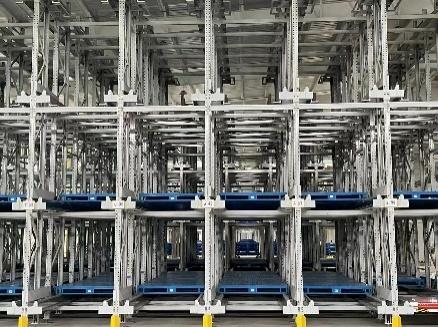
Physical dimensions set the first hard boundary. A shuttle built around a standard tote width will force every SKU that doesn't fit into either repacking or manual handling. Go wider or add adjustable guides and you can keep mixed container sizes in the same loop, but the trade-off shows up as looser positioning tolerance and slower cycle times. That's a design choice, and it quietly determines which SKUs ever reach the shuttle aisle.
Load capacity and stability matter just as much. If the lifting mechanism and rail set aren't rated for heavy bins, you'll end up splitting a dense SKU across multiple shallow storage positions or cutting the fill level per tote. That changes how the SKU sits in the system: one SKU may appear as several smaller units scattered along the aisle, which feeds into replenishment triggers and pick path logic. The design doesn't just store inventory—it reshapes the inventory profile.
Depth configuration is another decision that filters SKU placement. A double-deep layout can pack roughly 40% more storage into the same footprint, but it needs precise centering and retrieval routines to pull the rear tote safely. Once that is in place, slow-moving, high-volume SKUs naturally drift to the deep positions while fast movers stay up front. Over time, this physical sorting influences restocking intervals, cycle count frequency, and even the packaging standards your suppliers adopt.
Multi-Deep Lanes, One Shuttle: How Dispatch Logic Avoids Bottlenecks
In automated warehouses, multi-deep lane storage raises a classic bottleneck problem: a single shuttle serving multiple deep positions can get trapped behind slow retrievals or blocked by incoming pallets. The dispatch logic must decide not just which task to take next, but also how to sequence moves so that the shuttle never idles at a lane entrance waiting for a rack to be freed. Without smart ordering, the shuttle wastes cycles shuttling empty between lane mouths, and throughput collapses.
The core of avoiding bottlenecks lies in predictive task interleaving. Instead of reacting to the oldest request first, the dispatch engine scores each candidate move by its impact on future congestion. For example, it may prioritize a retrieval from the second-deep position if that frees the outermost slot for an incoming pallet already queued at the conveyor. Similarly, it batches putaway tasks into the same lane when possible, so the shuttle can fill multiple depths in one trip rather than making separate visits. Dynamic re-sequencing also kicks in when a lane becomes temporarily blocked: the shuttle gets rerouted to another lane with ready tasks, and the original task is reassigned without manual intervention.
The result is a dispatch logic that treats the shuttle not as a simple transporter but as a resource to be kept in constant, meaningful motion. By continuously evaluating lane occupancy, task due times, and physical travel distances, the system avoids the stop-and-go pattern that plagues naive FIFO scheduling. Multi-deep storage then becomes feasible with a single shuttle, because the logic smooths out the peaks and valleys of demand and keeps every lane flowing.
From Receiving to Dispatch: Where Shuttle Systems Remove Picking Friction
In most warehouses, the gap between receiving and dispatch is where the real chaos hides. Pallets arrive, get broken down, and suddenly every item needs to find its own path through a maze of aisles and bins. Shuttle systems erase that friction by taking over the middle mile—moving entire totes or cases directly from the dock to the pick face without a single walker wandering for a location. The result is a flow that feels less like piecemeal retrieval and more like a single, continuous handoff.
At the receiving end, shuttle buffers absorb the unpredictability of vendor deliveries. Instead of staging everything on the floor or forcing putaway into fixed slots, the shuttles accept goods as they arrive and slot them into dense, high-speed storage. From there, orders pull from the shuttle lanes in sequence, so pickers aren't hunting for a needle in a haystack—they're simply meeting the right container at the right station. It's the difference between asking someone to search a library and having the librarian slide the exact book across the desk.
By the time a carton reaches dispatch, the shuttle has already done the heavy lifting: consolidating SKUs, sorting by route, and staging outbound loads without a single lift truck cutting through pedestrian traffic. That removes the physical and mental friction that usually creeps into order fulfillment—no detours, no dead ends, no second-guessing where an item might be hiding. In warehouses where shuttle systems run from dock to dock, picking stops being a scavenger hunt and starts behaving like a quiet, predictable current.
Rack Depth, Pallet Weight, and the Numbers Behind Shuttle Selection
Shuttle systems don't get selected based on a catalog spec alone. Two measurements drive most of the initial feasibility work: how deep the rack lanes run, and how much each pallet actually weighs. A lane that extends 40 feet versus 12 feet changes the shuttle's duty cycle, acceleration profile, and heat dissipation requirements. Similarly, a pallet holding 2,200 pounds of bagged cement behaves very differently from one carrying empty plastic containers. These numbers set the boundaries for wheel materials, motor sizing, and even the communication protocol between the shuttle and the warehouse control system.
On the depth side, longer lanes mean fewer aisles for the same storage capacity, which sounds efficient until you calculate the shuttle's travel time per transaction. A shuttle moving 60 feet into a lane, grabbing a pallet, and returning covers far more linear distance than one working a 15-foot lane. That distance translates directly into battery drain, rail wear, and cycle time. For a system moving 200 pallets per hour, a 20% deeper rack can push energy consumption up by 30% if the shuttle was sized for shorter runs. Pallet weight compounds this: a heavier load demands higher torque at the drive wheels, which generates more heat in the motor windings and requires a beefier gearbox. Pushing 2,500 pounds through a 40-foot lane repeatedly will expose any undersized component within the first month of operation.
Beyond depth and weight, the real selection hinges on derived numbers: pallet moves per hour, average distance traveled per move, and peak demand during shift changes. A shuttle that handles 3,000-pound pallets in short, shallow lanes might be replaced by a lighter-duty unit if the pallets rarely exceed 500 pounds. Conversely, a deep-lane system with modest throughput can get away with a slower shuttle and smaller battery because the total distance per hour stays low. The mistake is treating shuttle selection as a single-point decision. It's a matrix where rack depth, pallet weight, and hourly throughput intersect with duty cycle and maintenance intervals. Get those numbers wrong, and you're either leaving speed on the table or burning through drive motors every quarter.
Beyond the Hardware: What Long-Term Support Looks Like for Shuttle Installations
When a shuttle installation goes live, the initial excitement often centers on the physical components—servers, racks, and cooling systems arranged just so. But real confidence comes later, when the system has been running for months and small, unglamorous things keep working: firmware patches arrive without drama, spare parts show up before a failure becomes an outage, and a knowledgeable engineer answers the phone at 3 a.m. without asking for a ticket number first. This is the invisible layer of long-term support, and it is what separates a short-lived deployment from infrastructure that quietly earns its keep year after year.
Long-term support for shuttle installations isn't a single contract; it's a rhythm. It means scheduled deep inspections that go beyond checking LEDs to measuring vibration, thermal drift, and power draw against baseline data. It means having access to design documents when a component is discontinued, so a replacement can be sourced or fabricated instead of forcing a risky redesign. It also means honest conversations about obsolescence—knowing when a module is still worth maintaining and when a targeted upgrade will save more money than another round of repairs. Vendors who understand this talk less about service-level percentages and more about what happens on the second Tuesday of every month when new vulnerability disclosures drop.
Perhaps the most overlooked part of long-term support is institutional memory. Shuttle installations often live for a decade or longer, outlasting the careers of the people who built them. A support model that includes detailed as-built documentation, annotated runbooks, and periodic on-site training for new operators prevents a machine from becoming a mystery box that no one dares touch. In the end, the best long-term support isn't about fixing things faster; it's about making the installation understandable, predictable, and adaptable—so that the hardware itself recedes into the background and the mission it serves stays in focus.
FAQ
It uses adjustable telescopic forks with a load range of 500 to 1,500 kg, so Euro, GMA, and non-standard pallets can be picked from the same lane without reconfiguring the rails. The onboard sensors check fork alignment before each lift to prevent jams.
A single-level shuttle paired with a high-speed lift typically moves 40 to 60 pallets per hour in a 30-meter-deep lane. Multiple shuttles on separate levels scale that linearly, and the WCS balances task queues to avoid lift bottlenecks.
Yes, with sealed battery compartments, low-temperature lubricants, and heated sensors it runs down to -30°C. We also add condensation drains on the rail ends and use stainless steel contact points so ice buildup doesn't cause misreads.
Each shuttle gets a moving safety zone from the WCS. If two zones overlap, the trailing shuttle decelerates and waits. Onboard laser scanners and absolute encoders also trigger an emergency stop if anything enters the lane unexpectedly.
Retrofit is possible if the upright spacing and floor tolerance meet our rail spec. Usually we can reuse the rack frame but replace the lane beams with precision tracks. For deep-lane configurations, new racking often gives better density and pays back faster.
A failed shuttle can be driven out manually via a tether or remote control, then swapped with a spare unit. Most recoveries finish in 15 to 20 minutes without emptying the lane, since the shuttle doesn't carry the pallet during transit.
It cuts aisle width to 1.5 meters and increases storage density by 40-60% over VNA. Compared to stacker cranes, the shuttle system costs less per pallet position and lets you add capacity level by level instead of buying another crane.
The shuttle controller exposes a REST API, and we provide a middleware module for SAP, Oracle, and Manhattan WMS. It synchronizes inventory in real time, handles wave releases, and schedules battery charging during low-demand windows.
Conclusion
High-density warehousing rarely comes with spare square footage, so ODM shuttle systems turn the aisles you already have into deeper storage instead of adding walls. The payoff starts with rack depth, pallet weight, and SKU behavior: a lane holding fast-moving pallets needs different shuttle logic than one holding slow movers, and ODM designs around those profiles rather than forcing a generic layout. When every aisle counts, this approach frees capacity without touching the building footprint, and it gives operators a clear path from receiving to dispatch where pallets arrive at the pick face without double handling.
Just as important is what happens after the racks go up. Multi-deep lanes can quickly jam if shuttles are dispatched without sequencing, so ODM coordinates shuttle movements to keep inbound and outbound flows balanced. That removes picking friction at exactly the points where delays used to build. Long-term, the numbers behind shuttle selection—rack depth, pallet weight, throughput targets—become the baseline for support, including maintenance and software adjustments that keep lanes moving as SKU profiles change. The result is less a one-time equipment sale and more a working system that adapts to the warehouse floor, which is what high-density storage should actually feel like.
Contact Us
Contact Person: Johnny
Email: [email protected]
Tel/WhatsApp: +86 18151010686
Website: https://lydstorage.com