

Motor Magnet Company Tips for Choosing High Quality Permanent Magnets
2026-08-18
Most motor magnet selection guides stop at pull force, but that’s where costly mistakes begin. We’re DAWA, a motor magnet manufacturer, and we see the same oversights again and again—wrong temperature ratings, mismatched coatings, and unrealistic tolerances. Here are the checks we recommend before you commit to a permanent magnet.
Why Magnet Grade Isn't Just a Number
A magnet stamped N52 might sound like the obvious choice over an N35, but the number only captures one slice of performance. It refers to the maximum energy product, essentially how much magnetic punch the material packs in a perfect, room-temperature setting. That figure tells you nothing about how the magnet will behave once it is heated, exposed to demagnetizing fields, or cut into a thin, flat shape.
The letters trailing the number carry equal weight. Grades like N35H, N42SH, or N48UH are not decorative suffixes; they flag how much heat the magnet can tolerate before losing strength permanently. A plain N52 might outperform an N42SH on paper, yet fall apart in a motor or sensor that runs hot. Ignoring those letters can turn a spec-sheet winner into a field failure.
Then there is the reality of manufacturing. Two magnets labeled N42 can differ in coating thickness, dimensional tolerance, and even the exact blend of rare earth elements used. That is why experienced engineers treat the grade as a starting point, not a verdict, and why a weaker number sometimes delivers the more reliable result.
The Coercivity Factor Most Buyers Overlook
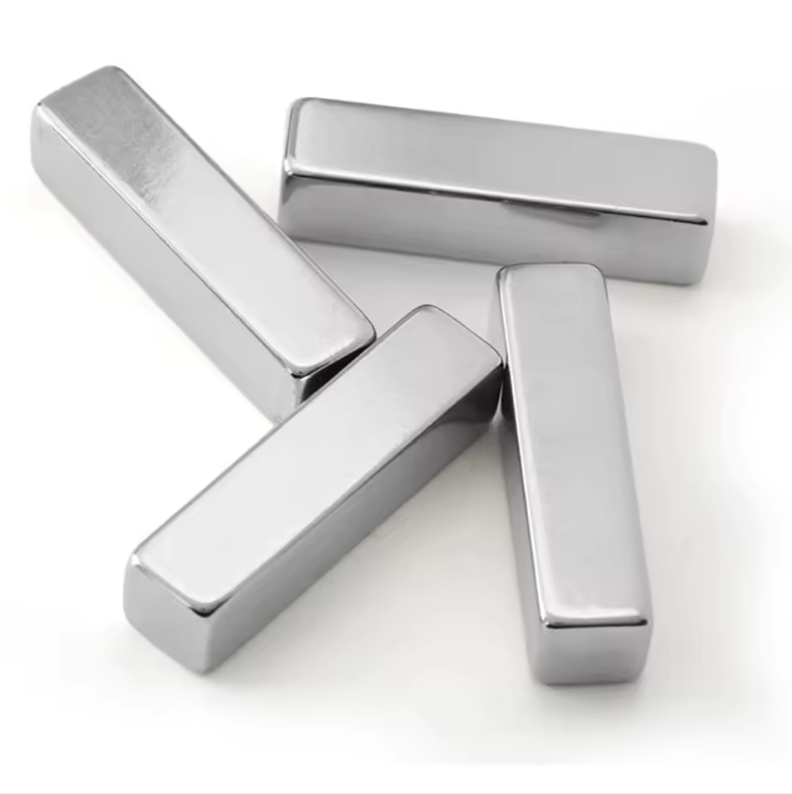
Most buyers fixate on pull force or surface gauss and never ask for the coercivity number. That single omission leads to magnets that look strong on day one but lose a chunk of their field after a few hot cycles. Coercivity measures how well a magnet resists being demagnetized by an opposing field or by heat, and it is not something you can infer from a gauss meter reading.
In practice, two magnets with the same remanence can behave very differently. A standard N35 grade may work fine at room temperature, but put it inside a motor housing that runs at 120°C and it can suffer irreversible losses. An N35H or N35SH with higher intrinsic coercivity will hold its strength under the same conditions for a few cents more per piece. Skipping that upgrade often ends up costing far more in warranty claims or rework.
Before you place the next order, ask your supplier for the Hcj value or at least the full grade letter, not just the N-number. Compare that against your actual peak operating temperature and any reverse fields from coils or neighboring magnets. Spending a little time on coercivity upfront keeps your application from quietly losing power after installation.
Temperature Limits That Quietly Kill Performance
Most hardware reviews focus on the headline shutdown temperature—usually 100°C or 105°C—but the quiet damage begins well before that. Modern CPUs and GPUs don't wait for a thermal trip to protect themselves; they start pulling back boost clocks in small increments as early as 70–80°C. By the time you reach the mid-90s, the chip may be running several hundred megahertz below its advertised peak, even though no warning light ever comes on.
This effect is especially brutal in sustained workloads like rendering, scientific computing, or long gaming sessions. A cooler that handles a 30-second burst without issue can still let the package temperature creep up over 20 minutes, gradually eroding the all-core frequency. Thermal soak in the PCB, VRM, and memory modules adds to the problem, so even if the core sensor reads 85°C, nearby components may be hotter and triggering their own quiet throttling.
What makes these limits so insidious is that they never show up as an error or crash. You simply get lower frame times, slower export speeds, or a machine that feels sluggish after an hour of use. If you're chasing consistent performance, monitor not just the peak temperature but the sustained clock speed during a 15-minute load. A 10°C drop in steady-state temperature often recovers more performance than any driver update.
Surface Quality: The Small Detail That Prevents Big Failures
In precision components, surface finish is rarely a cosmetic afterthought. A machined surface hides tiny grooves, tears, and microcracks that act as stress raisers. Under cyclic loading, these imperfections grow into fatigue cracks long before the part’s theoretical life expires. A crankshaft journal with a 0.8 µm Ra finish might survive for decades, while the same design at 3.2 µm Ra could snap in a few thousand miles—not because the material changed, but because the surface invited failure.
Sealing and wear add another layer of risk. A flange face with slight waviness may still bolt up flat enough to pass a visual check, yet leak under thermal cycling. In rolling element bearings, surface asperities collide, microweld, and tear away, generating abrasive debris that accelerates damage throughout the system. These failures rarely announce themselves with a warning light; they show up as unexplained pressure loss, noise, or sudden seizure.
The problem is that many shops still rely on a thumbnail or a quick visual comparison to judge surface quality. Optical profilometry and skidded stylus instruments can map roughness, waviness, and lay in seconds, but they’re often treated as optional. Ignoring a few microns of extra roughness or a wrong lay direction may seem trivial—until a $40 seal fails and takes out a $40,000 gearbox. Small surface details don’t just affect appearance; they quietly determine whether a part survives the loads it was designed for.
Tolerances Tell You How Serious a Supplier Is
Tight tolerances are not just numbers on a drawing; they reveal how much a supplier invests in process control. A shop that consistently holds ±0.005 mm doesn't get there by accident. It requires calibrated equipment, controlled environments, and operators who understand thermal expansion, tool wear, and measurement uncertainty. When you send the same part to two suppliers and one asks clarifying questions about the tolerance stack while the other says "no problem," the first is probably the one you can actually trust.
The way a supplier handles tolerance deviations is even more telling. A serious supplier will flag a borderline measurement before shipping, show you the data, and propose a corrective action. A less committed one will hope you don't inspect too closely. Look at their inspection reports: do they record actual values or just check "pass"? Vague checkmarks hide uncertainty; real numbers show they are not afraid of being measured themselves.
Also pay attention to how they quote. A supplier who immediately agrees to impossibly tight tolerances without discussing cost, capability, or alternative approaches is often just chasing the order. Serious suppliers will explain what it takes to hold a tolerance, maybe suggest a design tweak that achieves the same function more reliably, and tell you when something isn't feasible with their equipment. That honesty is a better quality indicator than any certification.
Coatings That Survive Real-World Conditions
Most coating datasheets read like wishful thinking once they leave the lab. The real test starts when a coated surface meets UV glare, salt spray, thermal shock, or constant foot traffic—and that's where many products quietly fail. What separates a reliable coating isn't just the resin chemistry; it's how the formula holds up when the environment stops being polite.
Look for systems that have been validated on actual structures, not just accelerated coupons. Field performance data from coastal installations, chemical plants, and high-abrasion floors reveals patterns you won't see in a spec sheet—edge retention, recoat windows, and resistance to micro-cracking under repeated stress. These are the details that determine whether a coating survives a decade or demands a redo in three years.
The smartest specifiers now ask for third-party weathering reports, cyclic corrosion test results, and references from similar exposure zones. Because in the end, a coating doesn't need to be perfect in theory—it needs to stay bonded, flexible, and intact when the real world does its worst.
FAQ
Look beyond the surface. A quality magnet should have consistent magnetic flux density across the batch, tight dimensional tolerances, and reliable coercivity at the motor's operating temperature. Cheaper grades often hide uneven plating or micro-cracks that cause field loss over time.
Samarium cobalt handles heat better than neodymium without losing strength, though it costs more and is brittle. If your motor runs above 150°C, don't just rely on a neodymium grade with a higher letter suffix; ask for actual demagnetization curves at your working temperature.
Request salt spray test results and inspect the corners visually under magnification. Many suppliers claim nickel-copper-nickel plating, but pinholes or thin edges lead to corrosion. A simple adhesion test with tape after thermal cycling also reveals weak bonding.
Insist on a full magnetic test report for every batch, not just a certificate of conformity. Compare the BH curve, not only the maximum energy product. Variations in the knee point or squareness factor can make two magnets with the same (BH)max behave very differently in a motor.
Not necessarily. After magnet thickness reaches a certain point relative to the air gap, adding more material gives diminishing returns and increases rotor inertia. The better approach is to optimize the magnetic circuit length and use a higher remanence grade if you truly need more torque density.
It tells you how much flux you lose as heat rises. For servo motors or EV traction motors, even a small difference in reversible temperature coefficient changes torque at peak load. Ask for the coefficient of coercivity as well, because it determines the risk of irreversible demagnetization under fault conditions.
Datasheets often show room-temperature values from ideal samples. You need to test samples under real conditions: after exposure to your motor's peak temperature, after mechanical stress from assembly, and after exposure to any cooling fluids. A reputable magnet company will help you run these validation tests.
For small sintered magnets, aim for ±0.05 mm on critical surfaces that face the air gap. Larger blocks may need ±0.1 mm. But be cautious: overly tight tolerances on every dimension can double the cost without improving motor performance. Focus on the mounting surfaces and the magnet thickness.
Conclusion
When sourcing permanent magnets for motor applications, the grade printed on a spec sheet rarely captures the full story. A higher number may suggest stronger pull at room temperature, but real motors rarely run in perfect conditions. The coercivity of the magnet—its ability to resist demagnetization from opposing fields or overloads—is often a better predictor of long-term reliability than the remanence alone. Many buyers skip over this because data sheets emphasize maximum energy product. Yet in a motor, transient current spikes and armature reactions create reverse fields that can permanently weaken a low-coercivity grade even if its nominal strength looks impressive. Temperature behavior compounds the issue. Neodymium magnets, for instance, can lose performance quickly above their rated operating point, and some grades suffer irreversible losses once they exceed a critical threshold. Choosing a magnet without mapping the actual thermal profile of the motor is a quiet route to field failures.
Surface condition and dimensional tolerance are just as telling as magnetic specs. Chipped edges, uneven plating, or porous coatings allow moisture and oxygen to reach the magnet body, leading to corrosion that no datasheet will predict. A supplier that invests in consistent surface treatment—nickel-copper-nickel, epoxy, or specialized multilayer coatings—signals the same attention to process that shows up in tighter tolerances. Magnets that arrive with loose thickness or width variation force assembly teams to shim, glue extra, or accept air gap inconsistencies, all of which hurt torque and efficiency. Coatings need to survive not just a salt spray test but the real environment: vibration, thermal cycling, and contact with adhesives or cooling fluids. Before committing to a batch, request cut samples from the actual production line, then inspect them for micro-cracks, uneven coating, and dimensional drift. A magnet that looks right on paper but fails under a wrench or inside a hot housing is not a bargain—it is a liability.
Contact Us
Contact Person: Kelvin Lo
Email: [email protected]
Tel/WhatsApp: 0769-88561131
Website: https://dawamagnetic.com/