

Leading Healthcare Wristband Kiosk Terminal Manufacturer: Enhancing Patient Safety and Workflow Efficiency
2026-06-30
In the fast-paced world of healthcare, every second counts—and so does every detail. Patient misidentification and workflow bottlenecks are persistent challenges that compromise safety and efficiency. Enter BAOBI, a pioneer in smart healthcare solutions. Their wristband kiosk terminals are not just gadgets; they're a leap forward in how hospitals manage patient data, ensuring the right care reaches the right person at the right time. Discover how this technology is transforming the patient experience while lightening the load on medical staff.
How Wristband Kiosk Terminals Improve Patient Identity Verification
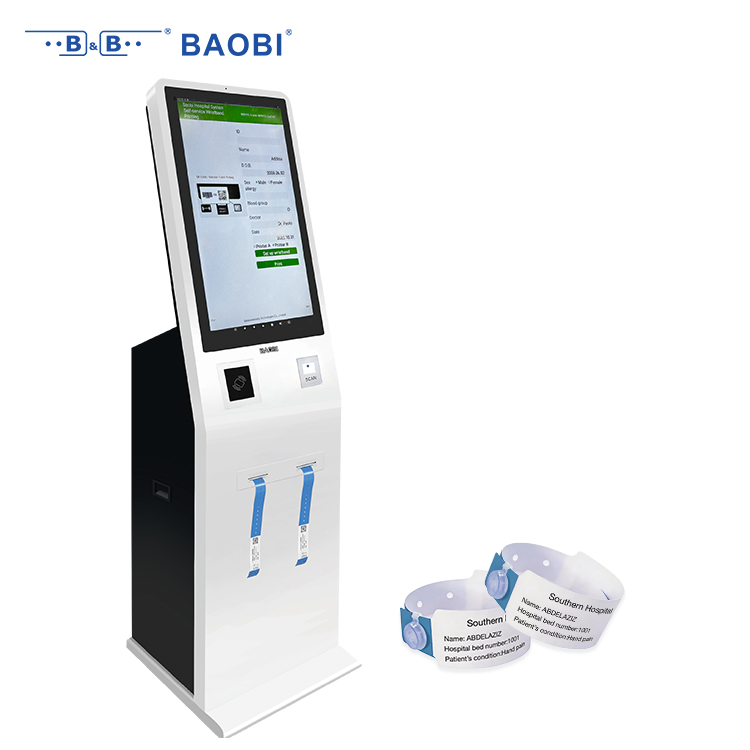
Mistakes in patient identity can lead to serious medical errors, from incorrect diagnoses to wrong-site surgeries. Wristband kiosk terminals tackle this head-on by shifting the verification process from manual check-ins to an automated, self-service model. Instead of relying solely on front-desk staff to match names and dates of birth against records, these kiosks let patients confirm their own details using driver’s licenses, insurance cards, or unique codes sent to their phones. This reduces the strain on administrative teams and cuts down on the miscommunications that often happen during busy intake hours.
The real strength of these terminals lies in their ability to cross-reference multiple data points instantly. When a patient scans an ID, the kiosk pulls up the corresponding electronic health record and may also capture a photo or require a biometric check, such as a fingerprint. Any discrepancy—like a misspelled name or outdated insurance—is flagged right then, and the wristband is only printed once everything aligns. Some systems even use RFID or barcode technology that links the band directly to the patient’s chart, so later scans at the bedside or pharmacy confirm identity without repeated questioning. It’s a closed-loop approach that keeps verification tight from arrival to discharge.
Beyond accuracy, these kiosks reshape the patient experience in subtle but important ways. Long lines at registration become shorter, and the process feels more private and controlled. For facilities managing high volumes, the drop in clerical errors directly lowers liability risks and avoids the costly fallout of identity mix-ups. Parents checking in a child or elderly patients with complex medication histories benefit especially, because the system ensures the right wristband goes on the right arm every time, without the usual back-and-forth. In practice, that means fewer near-misses and a smoother care journey overall.
Faster Check-in Processes Without Sacrificing Accuracy
The rush to welcome guests shouldn't mean cutting corners on data quality. Long queues often push staff to enter details hastily, which later causes billing errors or duplicate records. A smarter set-up lets guests submit their own information before arrival—through a simple online form or app—so that by the time they walk through the door, the system already has verified, clean data ready to go. This shifts the workload away from front-desk bottlenecks entirely.
But technology alone isn't the silver bullet. The secret lies in designing a check-in flow where accuracy checks happen behind the scenes. For instance, automatic ID validation or real-time cross-referencing with existing guest profiles can happen in milliseconds without anyone noticing. Staff only get prompted when a discrepancy pops up, keeping the face-to-face interaction brief and friendly while ensuring nothing slips through.
What guests remember isn't the screen they tapped—it's the feeling of being expected and valued from the first second. When the process is quick but thorough, trust builds instantly. And on the operational side, you avoid the headache of fixing messy records later, whether it's for invoicing, personalizing services, or complying with local regulations. Accuracy at check-in pays off long after the guest leaves.
Reducing Manual Data Entry and Associated Risks
When order forms still travel desk to desk on paper, even a careful data entry clerk becomes a liability. A misread digit in a shipping address or a quantity field swapped with a part number can cascade into wrong deliveries, billing disputes, and hours lost in reconciliation. These aren't hypotheticals—one mid-sized distributor we worked with uncovered a 3% error rate in manual invoice transfers, costing them nearly $70,000 in chargebacks over a single quarter.
The fix isn't about typing faster. Integrating direct data capture at the point of origin—through barcode scans, electronic forms that validate on input, and system-to-system API feeds—removes the fragile human transcription step altogether. Once live, the same distributor’s exceptions dropped below 0.2%, and the accounts receivable team shifted from correcting errors to managing exceptions that actually deserved human judgment.
Custom-Designed Terminals for Any Clinical Environment
Hospitals are not one-size-fits-all, and neither should be the technology they rely on. Our terminals are built from the ground up to match the specific workflow and physical constraints of each clinical area. Whether it’s a compact, wall-mounted unit for a busy nurse station or a mobile cart-based system for bedside care, every detail is configured for the space. Materials, screen size, mounting options, and peripheral integrations are all selected based on real-world use cases, not generic assumptions.
Infection control is built into the hardware. The fanless, sealed design prevents dust and pathogens from accumulating inside, while smooth, medical-grade surfaces can withstand aggressive cleaning agents used multiple times a day. Antimicrobial coatings are available for high-touch areas, and the lack of crevices means no breeding ground for bacteria. This isn’t just about durability—it’s about patient safety.
Beyond the physical build, the terminals adapt to the software and network landscape of each facility. They can run a variety of clinical applications and connect to legacy systems with ease, ensuring that staff don’t have to change their processes to fit the device. IT teams appreciate the remote management capabilities that reduce on-site maintenance, critical in environments where every minute matters.
Real-World Deployments in Busy Hospital Settings
Rolling out new technology in a hospital that never sleeps is nothing like a controlled pilot. The corridors are loud, staff are stretched thin, and any tool that adds seconds to a task will be abandoned by the end of the first shift. Successful deployments happen when the system blends into existing workflows instead of demanding new ones. For instance, an alert that pops up during medication rounds had better be something a nurse can act on within three taps, not a screen full of text requiring interpretation. One hospital found that a predictive sepsis tool was ignored until they embedded it directly into the vitals charting interface—where eyes were already looking—and pre-populated the alert with the specific vitals that triggered it.
Beyond the interface, the real differentiator is how the deployment team handles the first few weeks. Rather than dropping a finished product and walking away, teams that station a clinical informaticist on the floor during all shifts for at least a fortnight see dramatically higher adoption. This person isn't there to train in a classroom sense; they watch how the tool is actually used, catch friction points in real time, and tweak configurations on the fly. At a 900-bed trauma center, this approach turned a patient flow dashboard from a curiosity into a meeting-free coordination hub. Charge nurses began rearranging discharges based on predicted bottlenecks without a single huddle. That shift didn't come from a memo—it came from someone being present at 3 a.m. when the first confused nurse asked, “Why is this patient flagged orange?”
Ongoing Support and Technology Updates from the Manufacturer
Manufacturer support doesn’t end when the product leaves the warehouse. We see it as a continuous partnership, where your goals inform every update we roll out. Regular performance patches and security reinforcements arrive without disrupting your workflow, because they’ve been shaped by real-world feedback from users like you. Whether it’s fine-tuning a niche integration or hardening data protection for evolving regulations, the improvements you receive feel intentional rather than generic.
What sets this apart is the direct channel between our engineering team and the people who rely on these tools daily. Instead of broadcasting identical changelogs to everyone, we prioritize enhancements that address recurring challenges reported from the field. This means a logistics hub might get upgraded route optimization algorithms, while a research group sees new data visualization layers—each update custom-fit to how you actually work. It’s technology that learns, not just launches.
Behind the scenes, a dedicated lifecycle team monitors system health and upcoming compatibility shifts, so your operations stay smooth as surrounding ecosystems evolve. And when something unexpected crops up, our support doesn’t funnel you into a generic queue—you reach engineers who already understand your configuration. That’s the kind of sustained backing that turns a one-time purchase into a long-term advantage.
FAQ
It’s a self-service station where patients can check in, verify their identity, and print a durable, scannable wristband on the spot. This replaces manual registration and reduces paperwork at the front desk.
By ensuring accurate patient identification right from the start. The wristband includes barcodes or RFID that link directly to the right medical record, cutting down on mismatches during medication administration, lab draws, or procedures.
Absolutely. Staff no longer need to manually enter data or hunt down patient charts before issuing wristbands. Patients move through registration faster, and clinicians can access critical info with a quick scan.
The leading company designs kiosks that are built for 24/7 use, with intuitive touchscreens, rugged hardware, and deep integration with major EHR systems. They also offer custom wristband options to fit different hospital workflows.
Yes, the best ones integrate seamlessly via HL7 or API connections. They pull demographic data, insurance details, and even allergy alerts from your EHR, then update check-in status in real time.
Absolutely. Reputable manufacturers include encryption, role-based access, and auditing capabilities. Plus, kiosks often support biometric login or ID scanning to prevent unauthorized access.
Look for rapid wristband printing, antimicrobial coatings, failover connectivity, and a user interface that’s friendly for elderly or first-time users. Also check if the manufacturer provides ongoing firmware updates and responsive support.
Conclusion
In today's fast-paced clinical environments, ensuring accurate patient identification is the cornerstone of safety. A leading manufacturer has addressed this by developing wristband kiosk terminals that directly interface with electronic health records, instantly verifying patient identities at the point of entry. These kiosks eliminate the common errors associated with manual registration—misspelled names, swapped records, or outdated information—by scanning government-issued IDs or biometric markers and printing a durable, scannable wristband on the spot. This integration not only strengthens patient safety but also streamlines the check-in process, allowing staff to focus on care rather than paperwork. The terminals can be custom-configured to fit any clinical setting, from bustling emergency departments to quiet outpatient clinics, with form factors that adapt to wall mounts, mobile carts, or standalone pedestals.
Beyond the initial deployment, the manufacturer provides ongoing firmware updates and responsive technical support to keep the kiosks aligned with evolving healthcare standards. In real-world hospital settings, these terminals have drastically cut check-in queues and reduced wristband-related errors, as reported by several high-volume facilities. By automating data capture and printing, the risk of illegible handwriting or transposed numbers is virtually eliminated, freeing nurses and administrative staff to engage more meaningfully with patients. The manufacturer's commitment to continuous improvement means that security patches and new features—such as integration with payment systems or wayfinding apps—are delivered proactively, ensuring that the investment remains future-proof. Ultimately, these wristband kiosks represent a convergence of safety, efficiency, and adaptability, making them an indispensable tool in modern healthcare workflows.
Contact Us
Contact Person: Bill Xu
Email: [email protected]
Tel/WhatsApp: 8618688898707
Website: https://www.baobitech.com/