

High Quality Triisopropanolamine The Key to Enhanced Product Performance
2026-07-16
In the competitive world of specialty chemicals, the silent differentiator often lies in the subtlety of raw material quality. Triisopropanolamine, or TIPA, may not be a household name, but its role in optimizing cement grinding aids and concrete performance is nothing short of transformative. However, not all TIPA is created equal. The difference between standard purity and high-quality TIPA can determine whether your product merely functions—or genuinely excels. At HAISEN, we understand that superior formulations demand superior ingredients. In this post, we explore how premium-grade TIPA unlocks enhanced product performance, and why compromising on quality could be the most expensive mistake you never knew you were making.
Unlocking Superior Performance with High-Purity Triisopropanolamine
In the world of cement grinding aids and concrete admixtures, even trace impurities can dictate the line between mediocre and exceptional performance. High-purity triisopropanolamine (TIPA) eliminates these hidden variables, allowing its molecular structure to interact with cement particles in a far more predictable and potent manner. By removing contaminants that often compete for surface adsorption or trigger unwanted side reactions, manufacturers gain a tool that consistently amplifies late-stage strength development without the erratic behavior seen in lower-grade alternatives.
This level of purity transforms the grinding process itself. High-purity TIPA acts not merely as a passive additive but as an active process enhancer, reducing particle agglomeration and energy consumption while improving the overall particle size distribution. The result is a clinker grinding stage that requires less energy per ton, directly trimming operational costs. Beyond the mill, the cured concrete exhibits a denser microstructure, leading to heightened durability and long-term strength that standard grades often struggle to achieve, especially in challenging environments where every percentage point of performance matters.
End users who demand reliability in infrastructure projects, from towering wind turbine foundations to expansive bridge decks, find that the benefits of high-purity TIPA cascade into real-world advantages. The material not only helps meet stringent strength specifications earlier but also provides a buffer against variability in raw materials or curing conditions. By choosing high-purity TIPA, formulators are essentially engineering out a common point of failure, swapping guesswork for a dependable pathway to concrete that endures decades of service while keeping budgets in check.
Why Quality Triisopropanolamine Matters in Industrial Formulations
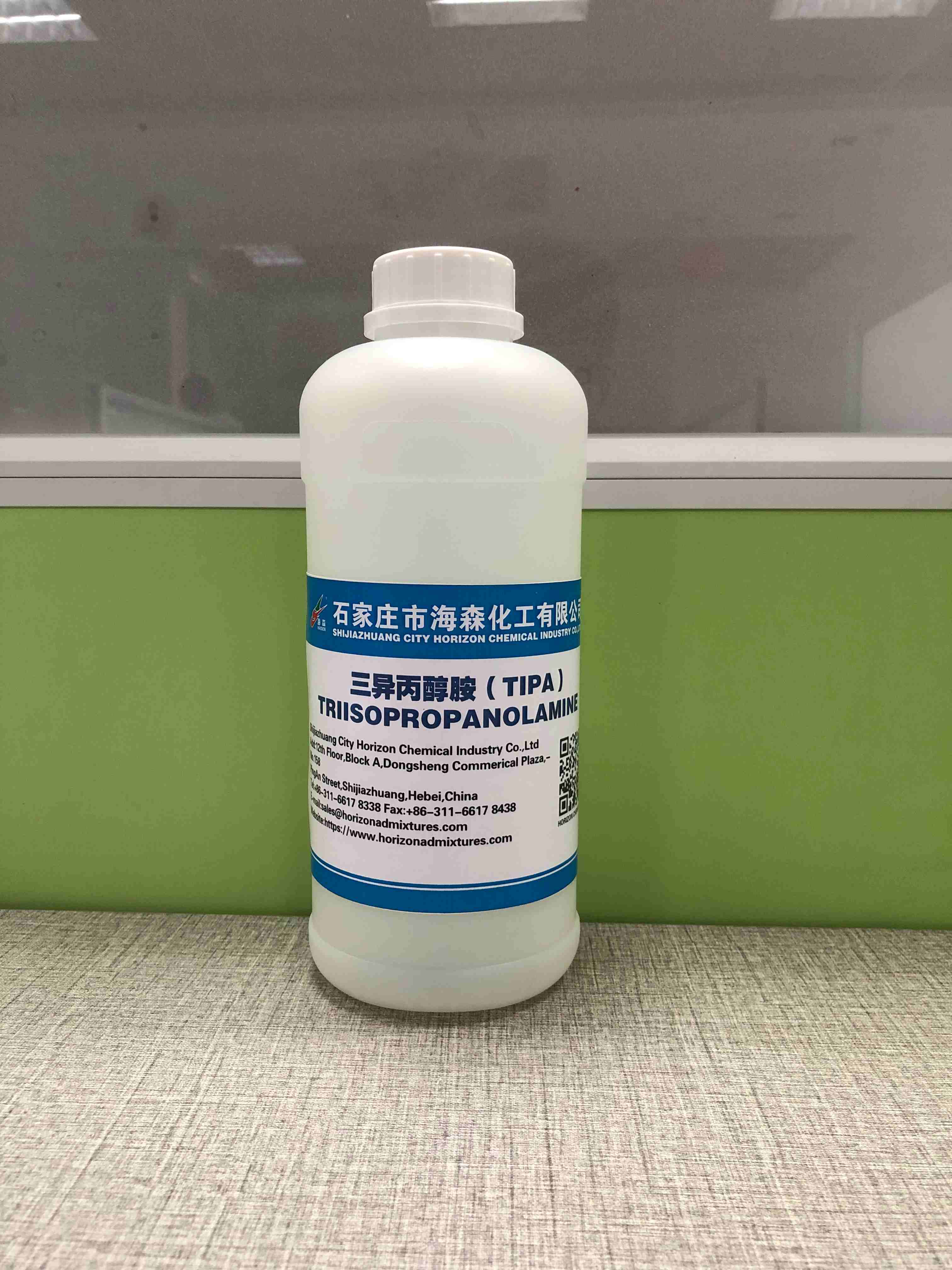
In the world of industrial formulations, the purity and consistency of raw materials can make or break a product. Triisopropanolamine (TIPA) is no exception. As a versatile alkanolamine, TIPA finds its way into cement grinding aids, concrete admixtures, and metalworking fluids, where it plays a critical role in performance. However, not all TIPA is created equal. Impurities or inconsistent composition can lead to unpredictable set times in cement, reduced strength development, or even corrosion issues in metalworking applications. Sourcing a high-quality TIPA ensures that these formulation challenges are minimized, allowing manufacturers to focus on delivering reliable end products to their customers.
Beyond immediate performance, quality TIPA contributes to the long-term stability and efficiency of industrial processes. In cement admixtures, for instance, TIPA works by chelating metal ions and dispersing cement particles, which enhances grinding efficiency and ultimate strength. A lesser-grade TIPA may contain by-products that disrupt this delicate chemical balance, forcing formulators to adjust dosages or compensate with additional additives. This not only complicates the manufacturing process but also increases costs and introduces variability. By choosing a consistently pure TIPA, producers can streamline their operations, reduce waste, and achieve predictable outcomes batch after batch.
Finally, in applications where safety and environmental impact are paramount—such as in water-based coatings or agricultural formulations—the quality of TIPA becomes even more critical. Low-quality variants may contain residual amines or color bodies that compromise the integrity of the final product, leading to off-spec odors, discoloration, or even regulatory non-compliance. A high-purity TIPA, on the other hand, meets tighter specifications and provides the peace of mind that formulations will perform as intended without unexpected side effects. Investing in quality from the start allows industrial formulators to build a reputation for reliability and trust with their clients.
The Role of Triisopropanolamine in Enhancing Product Durability
Triisopropanolamine, commonly known as TIPA, operates as a multifunctional additive that strengthens materials at a molecular level. Unlike many surface-level treatments, it integrates into the matrix, fostering cross-linking and reducing internal stresses that lead to premature failure. This inherent resilience translates into longer service life across a range of applications, from cementitious systems to industrial coatings.
One often overlooked aspect is TIPA’s ability to modulate the hydration process in cement, which directly influences long-term durability. By controlling the early-stage reaction kinetics, it refines the pore structure and minimizes microcracking. The resulting denser, more uniform material is better equipped to withstand aggressive environments, chemical attack, and freeze-thaw cycles without significant degradation.
In metalworking fluids and polyurethane formulations, TIPA acts as a steadfast stabilizer, preserving functional integrity under thermal and mechanical stress. Its chemical architecture allows it to scavenge reactive intermediates that would otherwise compromise the polymer network or promote corrosion. This protective mechanism ensures that the product not only lasts longer but also maintains consistent performance throughout its operational window.
Optimizing Production: The Impact of Premium Triisopropanolamine
Premium triisopropanolamine (TIPA) plays a subtle yet decisive role in streamlining production workflows. By acting as a highly efficient grinding aid, it reduces particle agglomeration during milling, which directly cuts energy consumption and increases throughput. This means fewer bottlenecks in the grinding circuit and a smoother path from raw clinker to finished cement, without compromising the chemical integrity of the product.
Beyond the mill, the real value of premium TIPA becomes evident in the hydration phase. It selectively enhances the reactivity of key clinker phases, particularly the ferrite and aluminate phases, while also improving the dispersion of silicates. The result is a tighter, more uniform microstructure in the hardened paste, which translates to higher early and late-age strengths. This predictability allows producers to fine-tune their blends with confidence, reducing the need for costly over-engineering of mix designs.
Another often overlooked benefit is how premium TIPA interacts with supplementary cementitious materials. In blends containing fly ash or slag, it helps activate the latent hydraulic potential, improving strength development without increasing water demand. This opens the door to higher replacement levels and lower clinker factors, all while maintaining consistent performance. For a plant manager watching both output and sustainability targets, that kind of operational flexibility is hard to overstate.
From Chemical Structure to Real-World Benefits: Triisopropanolamine Explained
Triisopropanolamine (TIPA) owes its versatility to a molecular backbone built around nitrogen and three branched isopropanol groups. This tertiary amine doesn’t just sit there — every hydroxyl and amine site participates in hydrogen bonding and metal chelation, which explains why it works as a grinding aid, a crosslinker, and a pH buffer all at once. The steric shielding from the isopropyl branches also slows down unwanted side reactions, giving formulators more control in reactive systems.
In cement production, TIPA isn’t added for show. It coats particle surfaces during milling, reducing agglomeration and energy consumption, while later boosting early strength development through accelerated hydration. Beyond construction, you’ll find it stabilizing polyurethane foams, scavenging acids in gas treatment, and even enabling low-VOC coatings. Each use traces back to that same structure — a balance of basicity, chelating power, and just the right amount of steric bulk.
Choosing the Right Triisopropanolamine for Maximum Efficiency
Selecting the ideal triisopropanolamine (TIPA) for your operation hinges on understanding purity, isomer distribution, and your specific application demands. Not all TIPA grades are created equal; variations in the ratio of triisopropanolamine to diisopropanolamine and other by-products can significantly influence performance in cement grinding, concrete admixtures, or metalworking fluids. A tailored approach, rather than a one-size-fits-all solution, is what separates peak efficiency from mediocre results.
For industries like construction, where TIPA is used as a strength enhancer in cement, the molecular structure matters. High-purity TIPA with a consistent isomer profile ensures predictable grindability and compressive strength development. Conversely, if your application is more forgiving or requires cost optimization, a technical-grade TIPA might strike the right balance between performance and budget. Always request a certificate of analysis and, when possible, run small-scale trials to observe how a specific TIPA variant interacts with your raw materials and process conditions.
Beyond the chemical specs, consider supply reliability and technical support. A supplier that offers flexible formulations or can adjust isomer content to match your evolving needs adds long-term value. Regular communication with your provider can uncover opportunities to fine-tune usage rates or even address hidden inefficiencies like foaming or viscosity issues. Ultimately, the right TIPA isn't just a chemical input—it's a strategic choice that drives operational consistency and lower total cost of ownership.
FAQ
Triisopropanolamine, often abbreviated as TIPA, is a tertiary amine that appears as a colorless to pale yellow liquid. It finds widespread use as an emulsifier, stabilizer, and chemical intermediate. In industrial settings, it serves as a neutralizing agent in metalworking fluids and as a grinding aid in cement production, where it helps reduce energy consumption and improve particle size distribution.
The difference lies primarily in purity and consistency. High-quality TIPA contains fewer impurities and by-products, which can interfere with chemical reactions or final product stability. This purity ensures predictable performance, better color stability, and reduced risk of unwanted side reactions, making it essential for sensitive formulations like polyurethane catalysts or cosmetic ingredients.
TIPA is a versatile additive used across several sectors. The cement and construction industry relies on it as a grinding aid to enhance strength and workability of concrete. It’s also found in agrochemicals as a solvent and stabilizer, in personal care products as an emulsifier, and in coatings and inks to improve flow and adhesion. Its ability to act as a corrosion inhibitor makes it valuable in metal treatment processes as well.
Absolutely. When used as a grinding aid, TIPA reduces agglomeration during the milling of cement clinker, leading to a finer and more uniform particle size. This enhances the hydration process and results in concrete with higher early and long-term strength. It also improves the overall workability and durability of the final mix, contributing to more efficient construction and longer-lasting structures.
Its molecular structure gives it a unique combination of properties—it acts as a base, a solubilizer, and a surfactant. This multifunctionality means formulators can simplify their recipes by using TIPA to perform multiple roles, such as pH adjustment and emulsification. High-quality TIPA, in particular, ensures these effects are consistent batch after batch, which is critical for large-scale manufacturing.
Using high-purity TIPA can lead to safer and more environmentally friendly processes. With lower levels of contaminants, there’s less need for extensive purification steps downstream, reducing waste and energy use. In applications like agricultural sprays, pure TIPA helps achieve better coverage with less product, minimizing chemical runoff. Additionally, its low volatility and biodegradability make it a less hazardous choice compared to some alternative amines.
Conclusion
The quality of triisopropanolamine (TIPA) is a critical factor in the performance and longevity of industrial products. High-purity TIPA brings unmatched consistency to formulations, whether in construction chemicals, polyurethanes, or metalworking fluids, by minimizing side reactions that can cause instability. Even minor impurities can compromise product integrity, leading to reduced durability and unpredictable outcomes. For applications like protective coatings or cement additives that face constant stress, the reliability of premium TIPA directly translates into longer service life and lower failure rates. Manufacturers who switch to high-grade TIPA often see fewer production hiccups—less batch rejection and smoother processing—because the material behaves predictably. This optimizes production costs and reduces downtime, making the initial investment in purity pay off quickly. In short, the right TIPA acts as a silent backbone, reinforcing product strength without drawing attention to itself, and its impact is most evident when quality is never sacrificed.
Behind this performance lies TIPA’s molecular design: a tertiary amine carrying three hydroxyl groups, giving it a rare combination of basicity, water solubility, and mild reactivity. These features make it an ideal neutralizer, emulsifier, or crosslinker, but only if the chemical�s composition remains pristine. Low-quality variants often contain residues from incomplete synthesis that can upset pH control, disrupt emulsion balance, or slow curing processes. Choosing the right supplier therefore becomes as important as selecting the chemical itself. Experienced formulators don’t just match technical data sheets; they seek partners whose manufacturing consistency ensures every barrel performs identically. This reliability simplifies product development and lets teams focus on innovation rather than troubleshooting. The result isn’t just a functional additive—it’s a foundation for creating goods that look better, apply more evenly, and satisfy customers. In a market where trust is hard to build, consistent high-quality TIPA gives products an edge that keeps them relevant far longer than one-time performance boosts.
Contact Us
Contact Person: Sam Lee
Email: [email protected]
Tel/WhatsApp: 86-311-6617 8338
Website: https://www.horizonadmixtures.com/