

Foton 4X2 Day-Old Chicken Truck Export Best Practices for Hatchery Transport
2026-11-16
Shipping day-old chicks across borders is never just about putting boxes on a truck. For hatchery managers running 4X2 routes, the first hours after loading decide everything: temperature stability, ventilation balance, and whether the flock arrives alert or stressed. The Foton 4X2 day-old chicken truck has become a common choice, but common equipment does not guarantee consistent results. What separates smooth export runs from costly losses is rarely the chassis itself. It is how the body, airflow, and loading routine are matched to the journey. This guide pulls together field-tested practices for hatchery transport, with a focus on the details that make the Foton 4X2 platform work harder. Along the way, we also look at how partners like KANGMU TRUCK approach specialized poultry body builds, because a reliable export program depends on more than just the base vehicle.
The Thermal Range Day-Old Chicks Actually Need in Transit
For newly hatched birds, the difference between a safe trip and a disastrous one often comes down to a surprisingly narrow band of heat. Most hatchery and welfare guidelines point to an in-box temperature near 32°C (90°F), with practical limits roughly 30–33°C depending on whether the birds are dry, the box is properly ventilated, and the trailer is moving. Below that, chicks burn yolk reserves just to stay warm; much above it, they pant, dehydrate, and pile away from the heat source instead of resting.
What matters more than the air temperature around the truck is the temperature inside the chick boxes. Crowding, moisture from newly hatched birds, and uneven airflow can create hot or cold pockets even when the vehicle's thermostat looks fine. Drivers and hatchery staff usually monitor at chick level, not ceiling level, and adjust in small steps because a shift of two or three degrees is enough to push mortality upward before any obvious distress shows.
Humidity plays a quieter role in that thermal range. Very dry air accelerates evaporative cooling from the birds and can make 30°C feel too cold; high humidity at the same temperature can suppress heat loss and lead to overheating. In a well-run transport, the goal is less about hitting one exact number and more about keeping the interior stable, dry enough to avoid chilling, and humid enough to protect the respiratory tract until placement.
Foton 4X2 Chassis Changes That Make Export Loading Easier
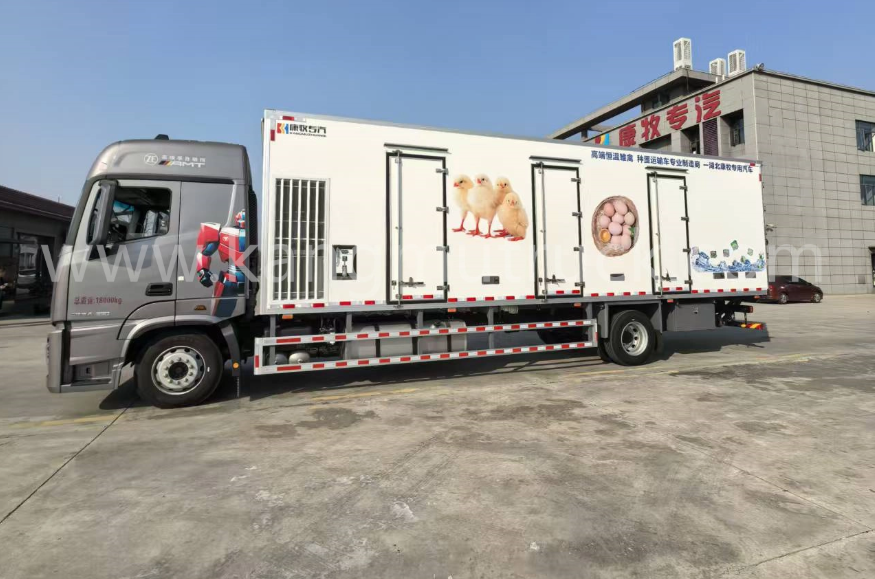
Foton changed the 4X2 chassis not by stripping parts, but by moving them inboard. The air reservoir, battery box and fuel filter cluster now sit tighter to the frame rails, leaving a cleaner outer face for lashing chains and wheel straps. The front mudguard brackets are bolt-on instead of welded, so handlers can remove them in a few minutes when clearance gets tight on the upper deck of a car carrier.
Several projections that used to catch on ramp edges were pulled back. The tie rod guard is slimmer, the rear shock absorber mounts no longer extend beyond the rail, and the exhaust tailpipe tucks above the frame line. Foton also added evenly spaced lashing eyes at the same height as common dock hardware. That means fewer crossed straps and less crawling underneath, which keeps loading crews moving at a steady pace.
The tank filler neck was lowered and a compact cab deflector is now available instead of the taller unit. That shaves just enough height to make container stuffing and low-deck RoRo work simpler, while the revised stowage points reduce the risk of paint damage during long haul export moves.
Why Air Speed at Crate Level Decides Batch Uniformity
Air speed is often treated as a bulk setting on a control panel, but what actually reaches each crate depends on stacking pattern, fan placement, and how tightly the product is packed. At crate level, small differences in airflow become large differences in heat removal or moisture transfer. A crate facing the supply duct may dry or cool quickly, while one tucked behind a corner stays warmer and wetter for hours. Those mismatches accumulate, and the batch finishes unevenly even when average conditions look correct.
Uniformity fails when the slowest crate sets the pace. If operators raise fan speed to compensate for dead zones, exposed crates can overdry or suffer surface damage before the center reaches target. The result is a batch that meets the average specification but contains outliers at both ends. Monitoring only return air or room-level sensors hides this spread because local air speed at crate surfaces never appears in the trend log.
Practical fixes usually start with mapping air speed across loaded crates, not just empty chamber tests. Adjusting stack gaps, turning crates to face the dominant airflow, or adding simple deflectors can narrow the range of surface velocities. When each crate sees a similar air speed, residence time, temperature pickup and moisture loss begin to line up. That is what turns a repeatable average into a repeatable batch.
Loading Density Rules for Long Hatchery Runs
Long hatchery runs put a different kind of pressure on fish than short transfers. When fry or smolts are packed for extended travel, the usual loading charts can fall short because oxygen demand climbs as the hours stack up, and ammonia builds in ways that a two-hour trip never reveals. A common starting point is to reduce density by roughly twenty percent for every additional six hours beyond the first four, but that alone is not enough. Water temperature matters more on longer runs, since warmer water holds less dissolved oxygen and speeds up metabolic waste production. Experienced haulers often set their upper limit by asking what the fish will weigh at the end of the trip, not at the start, and then recalculating biomass per liter from that shifted baseline.
The real constraint on a long haul is rarely the tank volume itself; it is the lag between the moment stress begins and the moment the system can be flushed or re-oxygenated. If a run extends past eight hours, many operations switch from static loading to flow-through or partial-exchange systems, which allows slightly higher densities but demands closer monitoring. A practical rule is to stay under thirty grams of fish per liter for runs lasting more than half a day, provided the water stays below ten degrees Celsius and oxygen is supplemented. Once the temperature climbs toward fourteen or fifteen degrees, that same run may need the density cut by half. Some hatcheries also factor in the condition of the fish before loading: fish that were recently graded or vaccinated carry a higher stress load and should be given more room than the standard tables suggest.
Another variable that gets overlooked is the time the fish spend waiting inside the truck before departure. Loading density on paper assumes the trip starts when the wheels move, but in practice the animals may sit in the tank for an extra hour or two while paperwork clears. That idle period consumes oxygen and produces waste without any distance gained, so it has to be counted against the total run time. A simple safeguard is to load at the density planned for the next longer duration bracket, or to delay adding the last fish until just before leaving. For very long trips, some managers also pull a small water sample every three hours and adjust aeration or reduce speed rather than risk losing an entire load to a miscalculation made at the loading dock.
Border-Ready Biosecurity Without Slowing the Delivery
Modern border biosecurity has shifted from treating every shipment as a potential threat to sorting risk before cargo even reaches the checkpoint. Pre-arrival documentation, historical compliance records, and live intelligence help inspectors focus on the small number of consignments that actually need closer attention. That means most low-risk freight can keep moving without a full physical inspection, and clearance becomes a continuation of the logistics flow rather than a long interruption.
Technology also does much of the heavy lifting without adding dwell time. Non-intrusive scanning, automated image review, and mobile inspection units fit into existing operational layouts instead of forcing cargo into separate holding areas. In many border facilities, clearance decisions are made while containers are still being unloaded, so the security check operates inside the normal workflow rather than creating a bottleneck at the gate.
The real test is consistency under pressure. A border-ready approach has to hold up during peak seasons, weather disruptions, and staffing shortages. That calls for clear escalation triggers, repeatable procedures, and enough flexibility to shift resources toward emerging threats while routine traffic continues to move. When the system is designed with that balance in mind, stronger biosecurity does not have to come at the cost of delivery speed.
Driver Checks That Catch Problems Before They Reach the Farm
A quick walk around the truck before departure often reveals what a dashboard warning light won't. Brake lines chafing against a frame rail, a loose mud flap dragging near a hot exhaust, or a slow drip from a hydraulic fitting can all be spotted in under ten minutes. Drivers who treat this as a routine habit, not a rushed formality, tend to catch failing components while they are still cheap and easy to fix.
The most useful checks are the ones that connect directly to field work: tire pressure on the implement trailer, PTO shaft guards that stay locked, and glad hands that seal on the first try. Listening to air leaks after the system builds pressure, or feeling for heat around wheel hubs after a short roll, can reveal problems that would otherwise surface halfway down a gravel road. These small observations save hours of downtime later.
Paperwork and load security also belong in the pre-trip routine. A shifting load or an unlatched tailgate can damage equipment before it ever reaches the field. Drivers who photograph their load before leaving, check chain binders twice, and keep a written note of any unusual noise or vibration give the farm a clear head start instead of a surprise repair bill.
FAQ
Its lighter footprint and reliable drivetrain suit the stop-and-go rhythm of hatchery runs, while the chassis leaves enough room for a custom insulated body without pushing axle loads beyond common road limits. Operators often find parts and service support easier to arrange in markets where Foton has an established distributor network.
Airflow should move evenly across every stack of chick boxes rather than blowing directly onto birds. Adjustable inlets near floor level and extraction fans at the roof help pull heat and ammonia out. Drivers need a simple monitoring point for temperature inside the cargo area, and the system should work in stages so it can hold a steady range between roughly 24 and 27 degrees Celsius without sudden drafts.
Keep the load centered over the rear axle, leave aisles between stacks, and avoid filling every floor inch so air can circulate under and around boxes. Stacks should be strapped but not compressed. The goal is to prevent shifting on rough roads while giving each box enough breathing room.
The unit should be cleaned dry first, then washed with a detergent suitable for livestock vehicles, disinfected with a product proven against poultry pathogens, and allowed to dry fully. Wheels, wheel arches, cab mats, and control panels are frequently missed. A visual inspection and signed cleaning record should be standard before the next load.
Chicks have no feed or water reserve once they leave the hatchery, so every delay directly affects condition. Routes should prioritize border crossing times, road surface quality, and backup crossings over distance. It often makes more sense to take a longer but smoother route than to shake the birds on a rough shortcut.
Veterinary health certificates, import permits, and proof of hatchery origin are common sticking points. The truck itself may need a cleaning and disinfection certificate, and the driver should carry clear documents linking the vehicle to the consignment. One practical step is to have digital and printed copies, because offline inspection areas may not accept phone-only records.
Use closed-cell insulation boards with a smooth, water-resistant inner lining, and avoid exposed joints where organic matter can collect. Floor drains with removable plugs help wash-out. The door seals need to be tight enough to hold temperature but simple enough to inspect and replace at a depot.
Smooth acceleration, early braking, and avoiding sharp turns reduce box movement. Drivers should also stop at planned checkpoints to feel inside air temperature and check ventilation fans, not just at border queues. Keeping a short written log of temperature readings and stops makes it easier to catch problems before they become losses.
Conclusion
Successful export of day-old chicks on a Foton 4X2 depends less on the truck itself and more on how precisely temperature and airflow are set before the first crate goes on. Day-old birds have almost no ability to hold body heat, so the load space should stay in a narrow thermal band around 24–26°C during transit, with adjustments based on outside conditions rather than driver comfort. The 4X2 chassis becomes easier to load when fitted with a low, flat floor and wide rear doors that allow ground-level access, cutting lift height and letting handlers stack crates without twisting bodies or blocking side vents. Even accurate temperature control fails if air speed at crate level is uneven. Static pressure, vent placement, and return air paths matter more than raw fan capacity, because a dead pocket above the rear axle or a cold spot near the doors can make a whole batch uneven within two hours.
Load planning for long hatchery runs should treat bird count, crate height, and empty space as one ventilation calculation rather than a simple packing task. Straight rows, a narrow centre aisle, and strict adherence to marked stack heights keep air moving through every crate instead of around the load. At export, biosecurity must also be border-ready without turning delivery into a long stop. Rear footbaths, sealed crate liners, disposable boot covers, and a washable floor can be inspected quickly, while the holding area stays protected from road spray. Driver checks should then focus on small changes that show up before the farm gate: a two-degree drift on the return air sensor, condensation on crate lids, a soft tyre on the loaded side, or a slight lean after a rough border crossing. Correcting those early keeps the shipment within the range chicks actually tolerate and prevents batch losses that only become obvious after placement.
Contact Us
Contact Person: Shen Zhikang
Email: [email protected]
Tel/WhatsApp: 8613908668969
Website: https://www.kangmutruck.com/