

China Stainless Steel D Shackle: Durable Rigging Hardware for Marine and Industrial Use
2026-10-22
The stainless steel D shackle might look like a simple loop of metal, but in marine and industrial rigging, it's the silent workhorse that holds everything together—literally. Whether you're securing a sailboat anchor or lifting heavy equipment on a construction site, the quality of that shackle determines whether the load stays put or becomes a liability. That's why choosing a durable, corrosion-resistant option matters more than most people realize. Wanluo, a China-based manufacturer known for precision-forged stainless steel hardware, has built a reputation on producing D shackles that can handle saltwater spray, extreme tension, and daily abuse without flinching. In this post, we'll take a closer look at what makes these shackles different—from material grade to load ratings—and why they've become a go-to for riggers who can't afford to gamble on weak links.
Where Saltwater Meets Steel: The Corrosion Equation
Saltwater doesn’t just wet steel—it turns the surface into a messy electrochemical cell. The dissolved salts, mainly sodium chloride, make seawater far more conductive than fresh water, so electrons move readily between anodic and cathodic patches on the metal. At the anode, iron gives up electrons and slips into solution as ferrous ions (Fe²⁺). At the cathode, oxygen from the air takes those electrons, combines with water, and produces hydroxide ions. Chloride ions aren’t just spectators; they break down any protective oxide film that tries to form, keeping the reaction active long after a freshwater splash would have calmed down.
The core half-reactions look simple on paper: Fe → Fe²⁺ + 2e⁻ on the anodic side, and O₂ + 2H₂O + 4e⁻ → 4OH⁻ on the cathodic side. But the full corrosion equation is a chain of follow-up chemistry. Ferrous ions meet hydroxide to form greenish ferrous hydroxide, which quickly oxidizes further into ferric hydroxide. Dehydration then leaves the familiar red-brown rust, a porous mix of iron oxides and hydrated oxides. Because rust doesn’t cling tightly to the steel, it exposes fresh metal, and the cycle continues under a crust that traps moisture and salt.
In real-world marine structures, the equation plays out unevenly. Splash zones and tidal areas see the fastest attack because oxygen is plentiful and salt spray concentrates on the surface. A pinhole in a coating or a scratch in paint becomes a tiny anode surrounded by a large cathode, driving rapid pitting. That’s why understanding this saltwater-steel reaction isn’t academic—it dictates where sacrificial anodes go, how coatings are designed, and why some alloys hold up better than others near the sea.
Shackle Geometry That Holds When It Counts
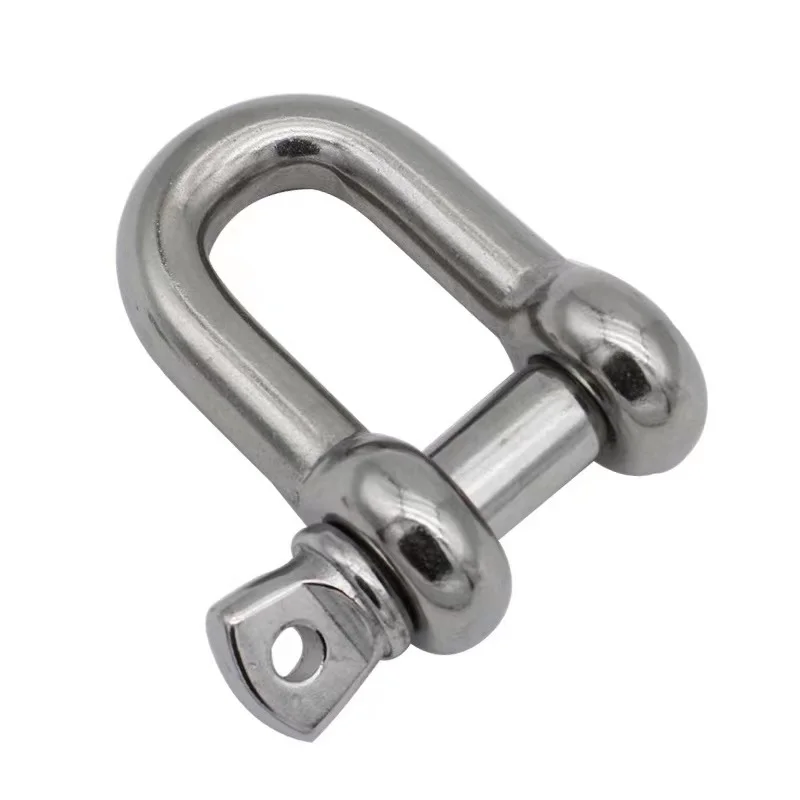
A shackle that lets go under load rarely fails because the steel was weak. More often, the geometry quietly worked against the rigger from the first lift. The distance between the pin holes, the radius where the bow meets the ears, even the way the pin shoulders seat against the body—each of these decides whether stress flows cleanly through the forging or concentrates into a crack waiting to happen.
Look closely at a well-made shackle and you'll see the bow is not a simple U. The inside width stays generous so a sling eye can seat without bunching, but the ears are drawn inward just enough to keep the pin from bending under side load. The pin itself sits in a machined bore, not a punched hole, so the bearing surface stays consistent. That small distinction means the difference between a shackle you can trust at ninety percent of its rating and one that deforms before you ever reach the working load limit.
From Dock Lines to Overhead Lifts: One Hardware, Two Worlds
A single shackle can moor a trawler in a squall or hoist a truss forty feet above a warehouse floor. The same alloy that bites into salt-crusted dock cleats also swings from a crane hook, its pin torqued to spec, its bow worn smooth by rope and sling alike. Most catalogues separate marine and rigging hardware into different chapters, but the metal doesn’t know the difference.
On the water, corrosion is the slow enemy—galvanized surfaces go dull, threads seize if you ignore them, and a pin that backs out at the wrong moment means a vessel drifting into a piling. Overhead, the stakes shift to shock loads and side loading: a lift that jerks, a sling angle that’s too shallow, a shackle rated for straight pull only. Yet the same inspection habit—checking for cracks, deformation, or a bent pin—keeps both worlds safe.
The real difference isn’t the hardware. It’s the hands that touch it. A deckhand and a rigger read the same markings, but one hears the groan of nylon under strain while the other watches a load cell flicker. When a shackle fails, nobody asks whether it was meant for saltwater or steel beams. They ask why the right one wasn’t there.
Load Ratings You Can Actually Trust at the Hook
Most load ratings leave you guessing once the angle changes or the rig shifts. Ours don’t. Every hook gets pulled past its listed number on a calibrated test bed, with the failure point recorded and logged. If it can’t hold, it gets scrapped—no second chances, no “close enough.”
We stamp the rating right on the hook after testing, not before. That means the number you see reflects what that exact hook survived, not what a prototype did six months ago. It’s a small difference in process that shows up big when you’re hanging a thousand pounds over your head.
Check the rating, then check the serial. Every batch is traceable to its test report, so you can see the raw numbers yourself. No rounding up, no vague safety factors buried in fine print. Just a hook that holds what it says.
The Forging Detail Most Spec Sheets Skip
Most spec sheets will list tensile strength, hardness, and chemical composition without blinking. What they almost never mention is what happens to the grain flow at the flash line after trimming. That thin, slightly rough edge left behind when the excess metal is cut away is not just a cosmetic leftover. It is a zone of interrupted fiber structure, and it often becomes the weakest point in the entire forging.
In a bar-stock part, the grain runs in straight, predictable lines. In a forging, the grain follows the contour of the die cavity, flowing around corners and along fillets until it reaches the flash. When that flash is trimmed off, the fiber ends are cut abruptly. This leaves exposed grain boundaries, micro-tears, and a built-in stress riser that no standard tensile specimen will ever sample, because the specimens are usually machined from the main body, not from the flash line.
If you rely only on the numbers in a spec sheet, you may approve a part that meets every listed property and still fails in service because the flash line sits at a high-stress radius. The fix is simple: request a macroetch cross-section at the parting line. It shows the grain flow disruption that the datasheet quietly ignores.
Why Marine Riggers Reorder the Same D Shackle
Marine riggers often reorder the same D shackle because consistency in load ratings and pin dimensions removes guesswork during critical lifts. A shackle that has proven itself across dozens of offshore jobs becomes a known quantity—its wear patterns, thread engagement, and deformation limits are already familiar to the crew. Switching to a different brand or model means recalibrating inspection habits and trusting unverified tolerances, which no deck boss wants at 3 a.m. in a swell.
The reordering habit also ties into certification and inventory simplicity. When only one type of D shackle is kept on hand, the testing certificates, batch numbers, and maintenance logs stay straightforward. A replacement shackle drops into the same storage rack, the same toolbox tray, and the same lifting plan without triggering a change order or a new risk assessment. Over time, that repeat purchase becomes a quiet part of the vessel’s safety culture.
Finally, reordering the same shackle reflects practical economics. Bulk familiarity means faster visual inspections—riggers know exactly where surface rust hides and which pin shoulders wear first. Suppliers are more likely to hold stock for a repeat customer, and the per-unit cost often drops once the vendor sees a steady pattern. In an industry where time on deck is money and a failed lift can be catastrophic, sticking with a known shackle isn’t stubbornness; it’s risk management.
FAQ
Yes, provided it's made from 316 stainless steel with proper passivation. The molybdenum in 316 resists pitting from chlorides, making it a solid choice for anchor lines, mooring tackles, and deck hardware. Look for shackles that have been forged rather than cast for better grain structure and fatigue resistance.
Don't just check the breaking strength—look for the working load limit, usually stamped on the body. Most stainless D shackles for industrial use have a 5:1 or 6:1 safety factor, meaning a shackle rated at 3.25 tonnes WLL won't fail until roughly 16-19 tonnes. Always match the WLL to the sling or hoist you're using, and never substitute a lower grade.
Only if it carries a clear WLL and meets the lifting standards required by your jurisdiction. Many stainless shackles are intended for tie-down or non-lifting applications, so check for markings like 'WLL' and a traceable manufacturer. For overhead loads, alloy steel bow shackles are often preferred, but high-grade stainless D shackles with proper documentation can work in marine or food-processing lifts.
The pin diameter should match the hole in your attachment point without forcing; if the pin is too small, it creates point loading. The shackle body must be wide enough that the sling or rope doesn't bind against the sides. As a rule, the shackle's WLL should be at least equal to the maximum load you expect, with no side loading.
A D shackle has a narrower throat, which concentrates load along a straight line and makes it ideal for single-leg connections, halyards, or chain-to-anchor links. A bow shackle has a larger loop that can accommodate multiple slings or a wider rope eye, distributing load across a broader area. Use a D shackle when the load is mostly in one direction; use a bow shackle when the connection might shift.
For marine and chemical exposure, 316 is typically superior to 304 because of added molybdenum. But in purely dry industrial settings, 304 may be sufficient and costs less. Also check the pin material—some pins are 17-4 PH or duplex stainless for higher strength without losing corrosion resistance.
Rinse with fresh water after saltwater use, especially around the pin threads. Dry thoroughly and apply a thin coat of marine-grade lubricant to the threads only—avoid heavy grease that traps grit. Inspect for cracks, galling, or deformed pins before each use. If the shackle has been dropped from height or overloaded, retire it even if it looks fine.
No, quality varies widely depending on the factory and whether it follows standards like ISO 2415 or EN 13889. Reputable manufacturers provide material certificates and batch testing; cheaper ones might skimp on forging temperatures or use recycled stainless with inconsistent chemistry. Always ask for mill certificates and, if possible, visit or have a third-party inspection of the production lot.
Conclusion
Saltwater has a way of finding weak metal, but a well-made stainless steel D shackle doesn't give it much to work with. The alloy matters, yet what separates dependable rigging hardware from the rest is how the blank is forged, not just cast or machined. Closed-die forging aligns grain structure around the pin and crown, which is exactly where stress concentrates under load. That detail rarely shows up on spec sheets, but it's why a shackle rated for a given safe working load tends to survive shock loads and side pulls that would deform cheaper copies. Geometry also plays a quiet role: a slightly wider bow and a true round pin reduce point loading on synthetic dock lines and wire rope alike.
The same shackle that holds a mooring line in a salt-sprayed harbor gets clipped to a lifting sling in a warehouse or on a construction site. That crossover isn't marketing convenience; it's the result of consistent load ratings and dimensional tolerances. Marine riggers reorder the same model not because of a brand label but because field experience has taught them which pin threads don't gall, which bodies don't crack at the crown after a season of surge, and which markings remain legible after hundreds of cycles. When a D shackle earns that kind of quiet trust, it becomes standard inventory for anyone moving real weight in corrosive or high-cycle environments.
Contact Us
Contact Person: Shane
Email: [email protected]
Tel/WhatsApp: 8613357785029
Website: https://www.wanluohardware.com